Glossary and Index of (mostly) Asian Art


Note: Click any text box below to generate a dynamic index (Google search within site) of the associated term, or enter your search term here:

Every culture must find a way to reconcile the polar opposites – male/female, good/bad, sky/earth, birth/death – that are characteristic of the human condition. Additive or non-dualistic cultures (Asian) accept such contradictions as imperfectly perceived parts of a greater unity: both/and, rather than either/or. Dualistic cultures (European) reject contradiction and spend enormous effort to resolve it. Ancient Egypt is uniquely a bit of both, since it accepts contradictions (additive, like the East) but also holds them in tension (dualistic, like the West).

Agastya, who is worshiped as an avatar of Shiva, was a legendary guru who spread the worship of Shiva throughout India. His attributes include a pot belly, a beard, and a water bottle.

The Vedic god of fire, and directional guardian of the southeast. He holds an offering spoon and rides a ram. Additional attributes may include a beard, a staff, a water jar, and prayer beads.

The popular center (Greek agora, Roman forum) of a classical city; its chief market and gathering place.

(Also Erawan) The three-headed elephant upon which Indra rides.

The third Mughal Emperor, known for his religious tolerance and the cultural brilliance of his reign.

An ornament on the ridge of a roof.

The Indonesian warrior ideal of imperturbability, that is similar to the Greek sophrosyne.

The ribbed disk at the top of a shikhara.

"Mother," one of the forms of Devi.

Amitabha, or Amida in Japan, is the Buddha of the Western Pure Land. He is associated with Avalokiteshvara and is easy to worship: just call on his name, and you will be reborn on top of a lotus in the Western Paradise. The cult of Amida supplied a practicable route to salvation for all, becoming especially popular in Japan from the 11th century onwards.

A group of five Buddhist deities with Amida at the center. From left to right, the figures are: Guanyin, a disciple, Amida, another disciple, and Mahasthamaprapta. See also: Table Of Buddhist Deities.

The Buddha of Longevity, a form of Amitabha.

(Indonesia) A culturally-defined state of murderous rage.

Ananta, also known as Shesha, is the cosmic serpent on which Vishnu sleeps, sits, or reclines (Anantashayana/Anantasayin), as he dreams the universe into existence. Shesha, "The One Who Remains," personifies the primordial substance out of which the universe is formed, that continues to exist when the universe ends, and that fuels the start of the next cosmic cycle. He is called Ananta, or "Endless," because the primordium is eternal and the cycle of cosmic birth and death repeats forever.

A disciplined process, pioneered by Dutch archaeologists in the early 20th century, of rebuilding the ruined stone and brick temples of India and Southeast Asia. It consists of the following steps: (1) The location of every existing block is carefully recorded. (2) The remains of the temple are disassembled, block by block. (3) The temple is then rebuilt, using knowledge preserved by the previous steps. (4) During reconstruction, any missing pieces are substituted by blank stones, and the entire structure is made architecturally sound and stable.

A classical bracket that is shaped like a scroll.

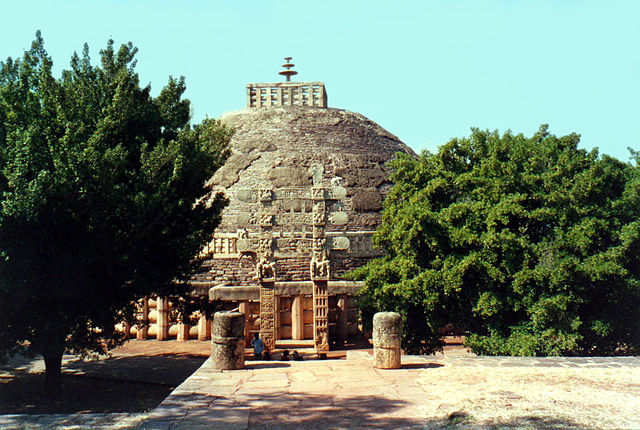
The bell-shaped or dome-shaped body of a stupa.

A demon slain by Shiva. Born from a drop of Shiva's sweat, Andhaka conceived an unnatural lust for his mother Parvati, which accounts for Shiva's ferocious antagonism. Andhaka is usually shown, either impaled on Shiva's trident, or in skeletal form as Bhringi after submitting to Shiva, who had drained his blood during the conflict. Another demon, named Nila, was a friend of Andhaka. Nila took the form of an elephant and attacked Shiva during the fight, but was killed by one of Shiva's attendants. Two representations of Shiva from this battle, often combined, are Shiva Andhakasuravadha (impaling Andhaka) and Shiva Gajasamharara (dancing on Nila's decapitated head, or underneath his butchered skin). Shiva fought a different battle with another of Parvati's sons, Ganesha, who had blocked Shiva's access to Parvati's bedchamber. Shiva beheaded Ganesha, and subsequently replaced his head with that of an elephant. Both stories seem to reflect a primal tradition where Shiva competes with a son or stepson for Parvati's favor. The elephant in these stories may symbolize the force of unrestrained passion.

(aniconic, adjective) The representation of divine beings in non-figural form, such as Shiva's linga, Vishnu's saligrama, or Buddha's footprint. Asian and European religious art overwhelmingly prefers the iconic image, while aniconism is dominant in the Middle Eastern art of the Nabataeans, Jews, and Muslims.

Nature-worship, the earliest expression of human spirituality, that also includes ancestor cult, shamanism, trance, spirit worship, totemism, and the genius loci. The first human beings lived in awe of nature - the earth and the sky, the mountains and stones, the woodlands and rivers, the storms, rain, and floods, the waterfalls and glens and meadows, and the plants and animals on which their lives depended. Animists consider the natural world to be populated by spirits who are alive and who can be encountered by shamans for the benefit of the community.

A small vertical member that is placed upon the corners of a roof in order to complete its profile.

In ancient Egypt, the jackal-headed god of mummification.

Turning away evil, as the Kala, the Chinthe, the Dvarapala, and similar guardian figures.

Celestial dancers, the wives of the gandharvas (celestial musicians.) Apsarasas are the beautiful maidens who delight the inhabitants of paradise. In Asia, the celestial realms were conceived of as analogous to earthly courts with palaces, gardens, kings and nobles, dancers, and musicians. In southeast Asia, from around the time of Angkor Wat, relief carvings of apsarasas took on special importance in temple decoration.

A "U" shaped chamber. In India this shape is called gajaprstika, which literally means an elephant's backside. See also: basilica.

The curved upper part of an opening, such as a window or door. It has the shape of a rainbow, with its feet in the earth and its head in the sky: Gateway Arch (St. Louis), Roman Arch, Gothic Arch, Venetian Arch (San Marco). Structural arches physically support the weight above their opening. When a structural arch is extended in depth, it becomes a vault (ceiling). The lintel is not technically considered to be an arch, because it is straight rather than curved. Often a non-structural arch is applied as decoration above a lintel. Relieving arches are structural arches, without an opening beneath, that are deployed to deflect weight from the upper courses of the building. See also: corbeled arch.

The true (curved) arch developed along a wide gradient from Roman Europe through Iran, India, and SE Asia; the lintel, a much earlier form, is found exclusively in Neolithic Europe, the Americas, and East Asia (China-Korea-Japan); it coexists along with the true arch in transitional areas such as India and SE Asia.

A named early period of art history, or an object or characteristic from such a period (e.g., Archaic smile).

An object whose form or decoration imitates the style of a much earlier artifact.

A contemporaneous image in relief of an architectural building. These images are especially valuable since they record, with allowances for artistic license and fantasy, how the buildings may have actually looked in ancient times.

In Indian architecture, the crossbeam of a torana. In Classical architecture, the lowest course of an entablature. See also: beam and lintel. Architraves, beams, and lintels are spanning elements that are carried directly on columns. Architraves are visual parts of the building's facade. Beams are structural parts of the building itself. Lintels span the top of a deliberate opening, such as a window or door, in the building's fabric.

A form of Shiva that is half male, half female.

A warlike, nomadic people from the steppes of the Caucasus who are variously said to have influenced, migrated into, invaded, or even colonized northern India, Europe, and the Middle East in the 2d millennium BC. This topic is very controversial. An Aryan cultural contribution to India is confirmed by linguistic (pater=pitar) as well as theological (Zeus=Indra) evidence, and of course Sanskrit is an Indo-European language. However an Aryan physical presence in India, although inferrable from the Vedas with their numerous accounts of warlike invaders, has not been confirmed by archaeological studies. See: Doniger, Chapter 4, pp. 85-102, and the Table of Eurasian Deities on this website.

Buddhist emperor of India (273-232 BC) and patron of Sanchi. Ashoka is the grandson of Chandragupta Maurya.

The sprinkling of holy water in church ritual.

A depiction of the night-time sky, with stars and constellations, on the domed ceilings of certain tombs in Egypt and Asia. About 25 astronomical ceilings, all from the Three Kingdoms period (ca. 400 AD), are known in Korea. Their decoration includes symbolic and mythological figures from Korean and Chinese lore.

An item that is associated with a deity, carried or worn on its person, and serves to identify it and to symbolize some aspect of its power. For example, Shiva's trident, or Vishnu's discus.

(Guanyin in China, Kannon in Japan) The Bodhisattva of Compassion. Avalokiteshvara is a Mahayana Buddhist savior associated with Amitahba, the Buddha of the West, with whom he often appears in triad alongside Mahasthamaprapta. Images of Avalokiteshvara can usually be identified by a small figure of seated Amitabha in the Bodhisattva's crown. His other attributes include a vase and a lotus. Avalokiteshvara was originally male in India, but became female (Guanyin in China, Kannon in Japan) during the Tang dynasty and later. Some of Guanyin/Avalokiteshvara's forms include:

(Japan) See Hayagriva.
A beloved form, sprinkling the waters of blessing from her bottle.
A fierce, horse-headed form, called Bato Kannon in Japan.
(Japan) An eleven-headed and thousand-armed form, to look upon and relieve all the sins and suffering of mankind. Called Qianshou in China.
A standing or sitting form, presented in a context that identifies Guanyin as the patroness of fishermen and Queen of the Southern Ocean (Nan Hai).
(China) See Juichimen.
The "Water-Moon" form, in which Guanyin sits in royal ease as she contemplates the moon's reflection in water; this is a metaphor for the illusory nature of phenomena (the moon's image is not the "real" moon).
Holding a child; the patroness of mothers.

An incarnation of Vishnu, in the form of a savior of mankind. There are ten major and countless minor avatars. Their names can vary somewhat, but one standard list includes, in chronological order:

A fish who pulled the ark of Manu during the Great Flood.
A tortoise who supported the mountain used to churn the Ocean of Milk.
A boar who saved the Earth from the Great Flood.
A man-lion who defeated a demon named Hiranyakasipu.
A dwarf who won back the universe from King Bali by transforming into Trivikrama and then crossing the universe in three giant steps.
"Rama with an axe," a brahmin (priest) who fought and defeated a hostile clan of kshatryas (warriors).
The hero of the Ramayana
A god-man who is fervently worshiped. Growing up as a mischievous boy among the gopis (milkmaids), he defeated numerous enemies, became Arjuna's charioteer in the Bhagavad-Gita, and was eventually killed by a hunter who mistook him for a deer.
A "false incarnation" who led the Hindu faithful astray.
A final incarnation who will appear at the end of the present epoch to lead mankind into a new Golden Age.

(1) Axial Age: the first millennium BC.
(2) Any temple complex whose approach is laid out upon a directional axis.

The ancient Egyptians, like the Chinese, believed in more than one kind of soul. To the Egyptians, these souls were fragments of the personality that were integrated in life, separated in death, and reintegrated after death to form a "blessed akh" or resurrected person in the afterworld. The Egyptian ka, or physical soul, was represented as a "ka statue" within the tomb; it sustained the afterlife of the deceased by receiving food-offerings. The spiritual soul, or ba, was represented as a bird in Egyptian art. It was able to move freely in the physical world outside the tomb, like the small birds that can be seen flitting about the necropolis. When reunited after death, the ba and ka resurrected as an akh to enjoy their afterlife in the fields of the blessed dead.

(Arabic: also betyl, pronounced "beetle":) A sacred standing stone ("god block") that represents a divinity. Schematic indications of eyes, nose, and sometimes mouth may be carved on the face of the block.

Krishna's older brother, who is also, like Krishna, an incarnation of Vishnu.

(Indonesia) an open pavilion. There is an accent on the final "e": balé, rhymes with "hey."

A roof that is curved to resemble a hut.

(Khmer; pronounced "bar-EYE") A very large, rectangular, shallow excavated reservoir for holding and releasing water. A baray such as the middle baray at Wat Phu might be 200m x 600m (600' x 1800') in length and width, but only about 5m (15') deep. Khmer Barays had multiple functions - religious, as symbolic of the oceans surrounding Mt. Meru; economic, as the source of irrigation water during the dry season; and political, as monumental demonstrations of the power of the Khmer kings. See also: tank.

The lion-like creature of good who dances against the evil witch Rangda in an Indonesian performance.

A roof or ceiling that looks like a semi-circular arch in cross section. The Sanskrit term is shala.

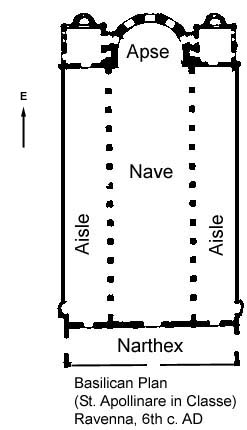
Originally a law court in the later Roman Empire, the basilica was adopted as the architectural form of early Christian churches. It consists of a long nave with columned aisles on either side, preceded by a narthex and terminated by a semicircular apse (plan). The altar is placed in the apse, which usually faces east.

A wax-resist cloth that is woven in Indonesia. See, for example: Batik, the Traditional Fabric of Indonesia.

The basic rectangular unit of a Chinese floor plan, as defined by the columns supporting the roof. Individual buildings like houses, temples, and palaces consisted of an odd number of bays (three, five, seven, etc.); the more bays, the more important the building.

A cross-member that supports the roof of a building.

(1) Traditional Asian bells are clapperless. They are made out of bronze, and produce their tone(s) by being struck on the side with a mallet or pole. Sets of suspended bells, called bianzhong, were paired with sets of suspended stone chimes and used in ritual and court music in ancient times.
(2) Any bell-shaped part of a stupa or other building.

A kind of "jingle bell" rattle that was used as part of a shaman's kit.

The bell and drum towers (separate buildings) were prominent features of any sizeable Chinese city. The bell sounded every morning to announce the beginning of the official day. When evening fell, the booming drum announced the curfew.

The "Song of God," a devotional hymn to Krishna in the Mahabharata.

A fierce form of Shiva as a wondering ascetic, when he was forced to do penance for cutting off one of Brahma's heads. He holds Brahma's skull cap as a begging bowl, often holds the head itself, and is accompanied by his vahana, a dog. This form shares many attributes with Bhikshatana. If the image does not wear sandals, it is definitely Bhairava. If the image does wear sandals, it is either Bhikshatana or an amalgamation of Bhikshatana and Bhairava.

Deep personal devotion to one's chosen god, a form of Hindu worship which arose in the early centuries AD as a response to Buddhism and in reaction against Brahmanic ritual. The Bhagavad Gita is a culminating expression of this ideal. Bhakti can be directed towards any god or goddess, but has been a particularly distinctive feature of the worship of Krishna since medieval times, and continuing on into the modern period.

Shiva in the form of "The Enchanting Mendicant," a wandering ascetic. Encountering a group of forest-dwelling Brahmins, he made love to their wives, and quarreled fiercely with the husbands. The quarrel was settled when he threw down his lingam onto the ground and made them worship it. In this form Shiva is naked, with a snake around his hips and sandals on his feet (the only representation in Hindu art of a god wearing sandals). The form is often amalgamated to Bhairava, in which case he is given Bhairava's attributes in addition to his own.

A hero of the Mahabharata. Bhima was the second of the five Pandava brothers, the largest and strongest. His stories are especially popular in Indonesia.

The gesture of Buddha's "calling the Earth to witness," pointing or touching the ground to prove his right to Buddhahood. In response, Bu Devi (the Earth goddess) confirms Buddha's past meritorious lives, by wringing out her hair at the Buddha's feet. From her hair pours a flood of sacred waters, every drop symbolizing a deed of merit performed in his previous incarnations.

(China; pronounced "bee") A flattened disk made of jade or stone with a circular hole in the middle. Bi are found in great quantities in elite burials from the Neolithic period onwards. They were used as personal ornaments in life, and, presumably, as offerings to Heaven in death (according to the "heaven is round" principle).

A Roman dining room with two benches.

A Japanese lute, like the Chinese pipa.

See tianlu

The species of tree (ficus religiosa) that sheltered the Buddha while he was meditating. Cuttings of the original tree were, it is said, propagated to Sri Lanka in early times, and later re-propagated back to India. Monasteries in Lanka plant a bo tree in their main courtyard, where it symbolizes the Buddha's enlightenment.

In Mahayana Buddhism, an enlightened being who postpones entry into Nirvana in order to help others achieve salvation. The Bodhisattva ideal eventually developed into a profusion of supernatural intermediaries between the Buddhas and ordinary people, very much like the Christian saints. Theologically these spiritual beings represented individual characteristics of the Buddhas like wisdom, compassion, power, and so on. In terms of practical worship they represented saviors that were more approachable to ordinary laymen than the remote and perfected Buddhas.

Because Bodhisattvas are still in the world, they are often portrayed with princely garments, jewelry, and elaborate coiffure. Different Bodhisattvas are emphasized in different traditions. They are generally divided into Bodhisattvas of Wisdom and Bodhisattvas of Compassion, since the two together make up the essence of a Buddha. Various traditions say different things about the same Bodhisattva, and the same thing about different Bodhisattvas. Bodhisattvas mentioned in the text include:

The native Tibetan animist and shaman religion, which influenced Tibetan Buddhist forms of worship and iconography.

(Korea) A classification of Silla aristocracy into five hereditary ranks, according to their degree of royal descent. Sacred bone (seonggol) was the highest rank. The Silla rulers originally came from this rank, but it died out after 654 due to a lack of heirs. Thereafter the rulers came from true bone (jingol), the second highest rank.

(Thailand) A temple building that is used for sermons, ordinations, and other monastic services, and may also house a Buddha image.

(Thailand) A temple building that is used for sermons, ordinations, and other monastic services, and may also house a Buddha image.
(Roman world) The meeting-place of a city council.

The Hindu creator god, with four directional faces. Brahma is also found in Buddhist sculpture, eventually making his way to Japan as Bon-ten. His vahana is a wild goose (sometimes called a swan, but Huntington, for one, insists that the latter term is mistaken.)

The universal soul, ie the All, as distinguished from the individual or personal soul (atman). In mainstream Hindu philosophy, Brahman = Atman, so that every person has the potential to achieve Godhood.

The highest (priestly) caste in India.

The female form of Brahma; one of the Seven Mothers.

An architectural design in which two half-pediments are separated by a void, recess, or some other feature.

(China.) Elaborate sets of ritual bronze vessels for cooking food, and for warming and serving wine, were cast from the Shang dynasty onward (overview.) These prestige items were granted by a lord to his vassal, and buried with the recipient when he died; the earliest long inscriptions in the Chinese language are dedications on ritual bronze vessels of the Zhou dynasty. Types of Chinese bronze vessels include:

A wine container.
A kettle for cooking; fang ding, a square ding.
A round food vessel.
A zoomorphic wine container.
A tall wine beaker.
A food cooker, with a bowl that sits on top of a rectangular base.
A wine vessel with a swelling, pear-shaped lower part and neck.
A wine container in the shape of a vase.
A vessel for warming wine that has none, one, or two suspension posts, either no spout or a short spout, no tail, a circular cross-section, three legs, and a strap handle above one of the legs. These vessels are sometimes called "jiao" in English.
A vessel for pouring wine that has two suspension posts, a long spout, a triangular tail, an elliptical body, three legs, and a strap handle on one side.
A wine container in the shape of a squared-off vase with a roof on top.
A water basin. The name is easy to remember, because by coincidence, the English word is the same.
A wine vessel
An open bowl. This word happens to be spelled the same as the "Zhou" dynasty, but it is a different word.
A wine container that has the shape either of an animal or of an inverted vase.

The historical Buddha was a Hindu prince (about 560-480 BC) named Siddhartha Gautama who renounced the world, achieved spiritual enlightenment through the practice of meditation, and founded the Buddhist religion. Buddha means "The Enlightened One" and is an honorific title. He is also called Shakyamuni, "The Sage of the Shakyas" (his birth clan). Technically the Buddha is not a god, but he is often worshiped as if divine. The life of Buddha began to be represented in art sometime before 100 AD. The major episodes in his life are: The Dream of Maya, The Birth, The Four Sights of human suffering, The Great Departure, The Temptation of Mara, Enlightenment, The First Sermon, and the Parinirvana.

Buddha was a contemporary of Mahavira, the founder of Jainism, and there are many intriguing parallels between the two religions. One interesting difference is that the historical Buddha was a meat-eater: his last meal, as recorded in all the chronicles, was a dish of pork. Vegetarianism was originally a Jain doctrine, and was also required in some Hindu sects; it only later came to be associated with Buddhism as well.

In terms of iconography, later Buddhism recognizes numerous past and future Buddhas in addition to the historical Gautama. A Buddha is distinguished by 108 (= two squared, times three cubed) special markings on his body, including: the urna, a whorl of hair in the center of the forehead; the ushnisha, a knot of hair on top of the head; and three folds of flesh around the neck. In Thailand (Sukhothai style and later), the top of Buddha's head is often surmounted by a flame that represents spiritual wisdom. The Buddha's four body postures, as represented in the art of Southeast asia, are: standing, walking, sitting, or lying down. His most important hand gestures (mudras) are bhumisparsha (calling the Earth to witness), varada (giving), abhaya (fear not), dharmachakra (setting in motion the wheel of the law), and dhyana (meditation).

The three great branches of Buddhism today are Theravada, Mahayana, and Vajrayana. Theravada, the tradition of SE Asia, emphasizes the Bodhisattva vow; it advocates contemplation and the monastic life as the means to salvation. This view was challenged, at first in India and later in East Asia, by the more relaxed Mahayana ("Greater Doctrine") school, that proclaimed the existence of numerous Buddhas and Bodhisattvas as universal saviors and incorporated many Hindu deities into the Buddhist pantheon. The Vajrayana ("Thunderbolt Doctrine") school is an Esoteric branch of Mahayana that took root in Tibet, where it continues to the present.

Buddhism died out in India around 1200 AD, succumbing to Muslim invasions as well as a resurgent Hinduism. However, by that time the religion had spread via trade routes to east and southeast Asia, where it struck deep roots and has flourished ever since.

Painted grottoes where Buddhist monks lived and worshiped during the first millennium AD. The grottoes were typically cut into the living rock of a cliff face above a flowing river, and decorated in vivid colors with paintings and statues on Buddhist subjects. Because of their rock construction and out-of-the-way location, many of them have been preserved to the present day, sometimes with dated inscriptions, which makes them an invaluable source for the history of early Buddhist painting and sculpture in Asia.

In Buddhism, guardian divinities protect the triratna (Buddha-Dharma-Sangha) as well as physical places like temples, special locations, etc. These deities are naturally usurped from the Hindu pantheon, since early Buddhism did not have gods of its own. Important Buddhist guardians include two Guardians of the Door (Dvarapala), eight Guardians of the Law (Dharmapala), and four Directional Guardians (Lokapala).

(Korea) A stone reliquary, in the shape of a small stupa, that holds the sarira of a monk.

(Japan) A masked court dance with orchestra, performed from the early Heian through the Muromachi periods. The orchestra is loud and includes drums, reeds, and strings.

(Japan) "Master Sculptor," a title.

(Pronounced chahn'-dee) The general name for a Hindu or Buddhist stone monument in Java.

An inflexible organization of Indian society by hereditary occupation. Introduced in the second millenium BC (by the Aryans, some say) this stratification persists down to the present day, in spite of legal prohibitions and the best efforts of modern India to eradicate it. There are four castes, in descending order: brahmins (priests), kshatriyas (warriors), vaishyas (farm owners, merchants, artisans), and shudras (menials, laborers, serfs). Below even the shudras are the untouchables, a group so low that they are completely outside the caste system: they include aboriginies, Western tourists, and ritually polluted workers such as street-sweepers, tanners, and corpse-handlers.

Armored horsemen, for example, in the Byzantine cavalry or the Three Kingdoms era in Korea.

A type of Chinese or Korean porcelain that is coated with a distinctive grey-green, high-fired, earthenware glaze. It is chiefly associated with the Song dynasty in China, and the Koryo dynasty in Korea.

(1) A mausoleum without a burial (literally, an "empty tomb.")
(2) In Mughal burials, a surrogate tomb that is located above the real tomb in order to receive public visits.

The ubiquitous ogee, circular/moon-shaped, or horseshoe-shaped arch,that decorates Indian temples and shrines. It is also called a gavaksha (or kudu, in Tamil) or a chandrashala.

A chaitya is any sacred place - a tree, spring, etc. In Buddhism, stupas are chaityas, and a building containing a stupa (functioning as a shrine) is called a "chaitya hall."

(1) "wheel," a solar symbol.
(2) Vishnu's
discus, a weapon.
(3) A supposed center of psychic energy in the human body.

An emanation of Durga. Chamunda, the most terrifying of the Seven Mothers, represents old age and death.

The founder of the Mauryan Empire, who defeated the invasion of Alexander the Great and consolidated much of present-day India under his rule (322-293 BC). Espousing the Jain religion after a lifetime of warfare, Chandragupta starved himself to death in 293 BC. His career is paralleled by that of his Buddhist grandson Ashoka, who also repented (late in life) of his former warlike acts.

A moon-shaped (chandra) chaitya arch.

The honorific umbrella that is: (1) held above the heads of kings and gods (Return To Kapilavastu), or
(2) used as an aniconic representation of Buddha (Indra and Brahma Visit Buddha), or (3) mounted on the spire of a Buddhist stupa (Plan And Elevation Of A Stupa).

The spire of a stupa. Originally it represented a tower of honorific umbrellas that sheltered the sacred enclosure (harmika).

A fly-whisk held by attendants of a god or royal person.

A stupa (Buddhist reliquary) in Southeast Asia. Chedi is the Thai word; zedi is Burmese.

A Mughal angled roof eave.

(1) A Mughal domed rooftop pavilion.
(2) A memorial pavilion in chhatri style.
(Japan) An alcove in a shoin interior, containing staggered shelves, where precious objects could be displayed.

The general term for any fictional animal whose body is a composite of various parts of real animals.

A lion-like creature that guards the entranceways to temples in SE Asia. In later Burma, the chinthe is often crowned and human-headed.

An akroterion in the form of a dragon-like makara that bites the end of Chinese ridgepoles.

Decorated doors in a shoin interior, originally leading to a bedchamber but no longer functional in the mature Shoin style.

Portable bronze statues of the Hindu gods, made for temple worship during the Chola period (9th-13th centuries AD) in South India. Chola bronze-work is one of the great artistic traditions in India, and includes sculptures of Shiva Nataraja and many other divinities.

A Tibetan stupa, characterized by a bud-shaped body that is supported by a rectangular base.

A sculpted date, in which the digits have been replaced by symbols.

A Hindu myth in which gods and demons cooperate to churn the primordial ocean, in order to produce amrita, the elixir of immortality.

(Hindu or Buddhist) A wish-fulfilling jewel.

A water-clock, that tells time by the steady dripping of water from a reservoir. It was invented by at least the 2d millennium BC in Egypt, the ancient Middle East, and Asia, and continuously developed until the beginning of the modern era in Europe.

A small column that is attached to a larger column or pillar.

An architectural supporting element that stands upright and is relatively slender in proportion to its length.

A Chinese philosopher who lived 551-479 BC, during the Spring And Autumn Period. His family name was Kong Qiu, and his honorific name was Kong Fuzi. His ideas were not accepted during his lifetime, but eventually came to form the basis of government and society in Asia. Confucius taught a pervasive hierarchy of superior and inferior that governed all social relationships, with reciprocal obligations and duties: ruler-subject, father-child, husband-wife, older brother-younger brother, etc.

(China; pronounced "ts/u/ng.") A Neolithic jade cylinder with squared-off corners, usually buried with the dead. Its exact meaning is not known today, but is usually explained in terms of heaven (the round hole of the cong) and earth (the square framework of the cong). More speculatively, the cong seems to resemble a human backbone (compare: the djed-pillar from ancient Egypt).

A pattern of stars, like the Big Dipper or Orion, that is interpreted according to myth and legend.

A pictorial composition that shows earlier and later parts of a story together in the same scene.

A triangular arch that is formed by horizontal courses of brick that are built up and in from each side until they meet at the top. Similarly corbeled vault, corbeled roof, corbeled dome. While a true (semicircular) arch can stand on its own, corbeling requires additional surround for stability; for example, corbeled tombs in Mycenae were buried under the ground, whose considerable weight then stabilized the entire structure.

An order of Classical architecture that is characterized by slender columns with acanthus-leaf capitals.

Examples of traditional Asian costume can be found on paintings, sculptures, mannequins, and vessels in museums; on the walls of tombs and temples; and in live and recorded music, dance, and theatre. While many pages on this website contain images of people or gods and what they are wearing, only the pages that talk explicitly about costume are indexed here.

The shell of the Money Cowrie, Cypraea moneta, is sourced from the Maldive Islands in the Indian Ocean; it was used as trading currency in Asia (and, along with other Cowrie species, in Africa) from early times. The cowrie's small size, light weight, durability, and sufficient (but not excessive) abundance made it ideal for this purpose, not unlike the manufactured coins that gradually replaced them. During the Bronze Age in China, cowrie shells had to pass through a long trade network in order to reach inland Southeast Asia and China; as markers of wealth, they are often found buried in significant numbers (hundreds at a time) in specially made or reused bronze containers.

In Asian art, cranes are symbols of longevity (they live about 30 years in the wild, double that in captivity). It seems odd that they are not more often employed as symbols of fidelity, given their spectacular mating dance.

A tooth-shaped series of projections on top of a castle or fort. Technically, the "teeth" are called merlons, and the crenellations are the spaces in between.

An Assyrian architectural design, adopted by the Nabataeans for the crowns of their tomb facades, that consists of triangular stairsteps, outlined in profile.

The horizontal members of a torana.

The ancient cultural and political heartland of Sri Lanka, located in the northern plains and roughly bounded by the island's three pre-modern capitals: Anuradhapura in the northwest, Polonnaruwa in the east, and Kandy in the south. See: Map of Sri Lanka.

Another name for a stupa.

The form of Shiva as supreme teacher of Yoga.

(China.) The Dark Warrior (Xuanwu) is the Chinese directional symbol of the North. Originally a constellation, visualized as a paired turtle and snake, the symbol changed over time into an anthropomorphic warrior.

(China.) The spiritual tradition of Laozi. Dao means way, path, or road. Daoism seeks to cultivate a mystical unity between man and nature, in the context of yin/yang polarity and a variety of philosophical, religious, spiritual, and magical practices. Laozi, Buddha, and Confucius are the three great progenitors of the East Asian spiritual and philosophical tradition.

(India.) "Seeing," the devotional viewing of an image during worship, or the ceremonial viewing of a ruler during public audience.

A Hindu shrine that is associated with a Buddhist temple conplex.

The personal god (tutelary divinity) of the king. Every Khmer king associated himself with a particular divinity, usually a form of Shiva, who protected the king and validated his rule. Moreover, the concepts of king and god overlapped each other: both were powerful, revered, blessed, rich, and the like. The devaraja represented their intersection: a fragment of the god, that also belonged to the king. This divine spark was worshiped in a state temple, by the king himself, during the king's life; and in the king's funerary temple after his death. The idea in Southeast Asia comes from India, but is not unique to that part of the world: there are reliefs in Egypt that depict Pharaoh sacrificing to himself, and the ancient Romans also sacrificed to the divine spirit (genius, in Latin) of their Emperor. In Cambodian art, the kings, and also their queens, were frequently portrayed as the gods or goddesses with which they were associated.

The Great Goddess, who is worshiped in India under a multitude of distinct forms. Any female deity in India can be considered as an aspect of Devi, even when consorting with a husband (Parvati), but especially when acting independently (Durga, Kali, etc.)

(1) (Lower case.) Right behavior, that which a person ought to do (compare ma'at, in ancient Egypt). In Hinduism, this usually amounts to traditional behavior consistent with one's status in life. The dharma of a warrior is to fight, the dharma of a student is to study, etc.
(2) (Upper case.) "Law," the Buddhist teachings.

The metaphorical Wheel (chakra) of the Law (Dharma), that Buddha set in motion with his First Sermon.

The hand position, in images of the Buddha, that signifies his First Sermon.

"Protectors of the Law," nominally eight Wrathful Deities of Tibetan Buddhism (but not all wrathful deities are Dharmapalas). It is a flexible category, that usually includes:

The Heavenly Guardians of the eight directions. Four of these, called Lokapalas, guard the four cardinal directions. The Dikpalas were originally Vedic gods, who became transformed into directional guardians in Hinduism and Buddhism. Text references include Parshvanatha Temple in Khajuraho (Hindu, Dikpalas) and Todai-ji Temple in Japan (Buddhist, Lokapalas). The Hindu Dikpalas are:

Symbolic animals that guarded the four cardinal directions in a tomb; the imagery comes from China. The figures are Blue Dragon (E), Red Bird (S), White Tiger (W), and Dark Warrior (N).

(1) In India the discus (chakra) is a solar attribute of Vishnu, a hand-thrown weapon that is shaped like the disk of the sun.
(2) In the Olympic Games of ancient Greece, and subsequently in Europe, the discus throw is a sporting event.

An inverted hemispherical roof that covers many ancient and modern buildings and symbolically represents the vault of the heavens. Celebrated domes include the Pantheon and St. Peter's in Rome, the U.S. Capitol, Aya Sophia in Constantinople, the Duomo of Florence, and many others. Structurally, they are classified either as "corbelled" (early Egypt, Greece, Korea) or as "true" (Rome and later), depending on whether they are technically rotations of the corbelled arch or of the true arch.

An order of Classical architecture that is characterized by "pincushion" capitals, alternating triblyphs and metopes, and unbased columns (Wikipedia article; Doric Order of Classical Architecture; Doric Greek Temples in Sicily).

The supporting or ornamental brackets that are used in the construction of Chinese wooden buildings. Dou are the square supporting blocks, and gong are the u-shaped bracket arms.

A water snake (naga), originally the god of its local pond, river, or lake, who grew wings and flew away to become a rider on the storm. Its manifestations include the Chinese emperor (a five-fingered dragon) and the serpent rainbow of Asian and Mesoamerican lore.

(China) An auspicious chimera that combines the body of a turtle with the head and tail of a dragon.

The overhanging upper edge of monastic cave-dwellings in ancient times. It was cleverly worked in such a way that rainwater would drip down vertically from it, rather than flowing back into the interior of the chamber.

The familiar drums made out of wood and hide are found everywhere in Asia; there are also early drums in southeast asia that are made out of bronze, and even earlier prehistoric drums in China that are made out of pottery and hide.

The bell and drum towers (separate buildings) were prominent features of any sizeable Chinese city. The bell sounded every morning to announce the beginning of the official day. When evening fell, the drum announced the curfew.

A fierce form of Devi who was created by all the other gods and given their combined powers; usually posed as "Mahishasuramardini," slayer of the buffalo demon (ashura) Mahisha. Her vahana is the lion.

(Kongōrikishi or Niō in Japanese.) A guardian figure placed on either side of a shrine or temple doorway.

Different architectural ways of visualizing a three-dimensional building or site in two dimensions. The elevation (outline, skyline) is a vertical projection as seen from the side, and the plan (floor plan, site plan) is a horizontal projection as seen from above. Axonometric projections are also used in architecture; although they may seem more complicated at first, they are really just projections from different angles than the horizontal or vertical.

An attached column that is partly set into the wall behind it.

1. In Roman civil architecture, a decorated semicircular recess that serves as a "conversation nook."
2. In Church architecture, the semicircular recess where a bishop would be seated.

The decorated front of a building.

(Cambodia) A Jayavarman VII-style tower that presents four carved faces overlooking the cardinal directions. The faces probably represent Jayavarman VII as Avalokiteshvara, the Bodhisattva of Compassion.

A type of Qing-dynasty polychrome porcelain that is decorated in a palette of green with other colors. Similarly famille rose (pink), jaune (yellow background), and noir (black background).

(Thailand) A foreigner; the word is derived from the Thai pronunciation of "French."

(ho-o in Japan) An auspicious bird that ruled over all others and, as the Red Bird, was a directional symbol of the south. In Ming times, it was also the symbol of the empress; when paired with the dragon, symbol of the emperor, it suggested marital harmony. The fenghuang is a mythical bird; it is mistranslated as "phoenix" into English, but it is not related at all to the Western phoenix.

Geomancy, the art of situating buildings and cities in a favorable context of surrounding landscape. Ideally, the site will face south, where the sun shines, and will be protected by a mountain range from the cold north winds; water will flow without impediment from west to east through the precincts, and refreshing greenery will be distributed throughout.

A Buddhist pentad with Shakyamuni in the middle, flanked on Shaka's left by Ratnasambhava (South) and Akshobhya (East), and on Shaka's right by Amitabha (West), and Amoghasiddhi (North).

A Han Dynasty system of thought that associated terrestial elements (seasons, the cardinal directions) to celestial phaenomena (constellations, planets) and metaphysical concepts (the Five Elements, the rise and fall of yin and yang).

Twin stone pillars that support the wooden flagpoles of a traditional Buddhist temple.

An aniconic representation of a deity by means of an image of the sole of his foot.

The native tutelary gods of Sri Lanka: Saman on Adam's Peak, Kataragama (Skanda), Upulvan (Vishnu), and Vibhishana.

A geometric form, such as a snowflake, that repeats itself at different levels of size. Fractals were first defined by Benoit Mandelbrot in 1975, although some of their forms and properties had been intuited much earlier by ancient Greek, Islamic, and Indian geometers and artists.

(Japan) A sliding screen made of paper over a wood frame, often decorated with painting, and used as a room divider.

(China) Brother and sister culture heroes, who gave to mankind the arts of writing and fishing.

A peaked vertical roof-end, a form that is found world-wide.

(Japan) The ancient music of the Japanese imperial court. Example: Kitanodai Gagaku Ensemble.

The goddess Lakshmi, usually seated, being lustrated (anointed with water) by two elephants (gaja) as a symbol of prosperity.

The apsidal shape of an elephant's (gaja) backside.

(Literally, "elephant-lion.") A decorative motif that shows (1) a lion rearing over or attacking a kneeling elephant, or (2) a combined elephant-lion creature. Its symbolism in either case is unknown, although much-discussed.

The Indonesian orchestra, that consists of gongs, metallophones, drums, flute, rebec, etc.

A dwarf-like, auspicious nature-spirit that is often found decorating the temples and shrines of India and Southeast Asia. In Hinduism, the ganas are servants of Shiva (the name of Shiva's son, the elephant god Ganesha, means "Lord Of The Ganas.") In Buddhism, the ganas are servants of Kubera, the god of wealth.

An ancient kingdom (1st century BC - 7th century AD) in what is now northern Pakistan and Afghanistan, important in the early centuries AD as the conduit of Roman stylistic influence in Buddhist sculpture.

"Fragrances," celestial musicians and husbands of the apsarasas.

(Also, Ganesh.) An elephant-headed god who overcomes all obstacles with the force of an elephant crashing through the jungle. The son of Parvati, Ganesh removes removes every difficulty and is invoked at the start of any new enterprise. His attributes include an elephant goad, his broken-off tusk that he used as a pen to write the Mahabharata, a lasso, and a bowl of sweets. He rides a mouse or rat and is a jolly, good-natured god.

(1) The Ganges is the most sacred river in India, flowing down from heaven through Shiva's hair in the high Himalayas and from thence east across India to the sea. To bathe in the Ganges river at Varanasi is to wash away all the sins of one's past lives. Ganga is the personified goddess of the Ganges river. She rides upon a makara, and is an emblem of fertility and purification.
(2) The Jumna, although less important today, is a parallel river to the Ganges. Her personification, Yamuna, rides a tortoise.

"Womb chamber," the sanctuary of an Indian temple.

Chinese gardens, which can range from the modest to the very large, are built from the three basic elements of water, plants, and rock according to aesthetic criteria that were codified in the Song dynasty. Garden rocks had to have a mountain-like shape with natural cavities; the best ones came from Lake Tai. Scholars' rocks were smaller versions of these. Japanese gardens tend to be a miniaturized and more formal version of Chinese gardens, perhaps reflecting the lesser availability of land on the Japanese islands, although there are some exceptions on very large Japanese estates. Compare: the relationship between 18th century French gardens (formal) and 18th century English gardens (informal).

A bird-man, Vishnu's mount. Garuda is the enemy of snakes, and can often be seen grasping them in his claws. His iconography encompasses a variable mixture of human and avian features, but usually includes at least a pair of wings and a beak.

See: chaitya arch.

A Sri Lankan Buddhist shrine in the South Indian style, fashioned of stone in a rectangular plan with corbelled roof and decorated with carvings.

(Japan) Literally, "accomplished person." A traditional female entertainer who provides music, song, dance, and conversation at dinner parties.

A flight of steps that lead down to any large body of water (whether natural or artificial) for bathing, washing clothes, etc.

(Japan) During the Asuka and Nara periods, a pageant with masks that was performed during temple inaugurations. It derives from the ancient Chinese state of Wu.

The comma-shaped, jade "bear claws" that decorate early Korean crowns. They symbolize royal authority and may derive from a totemic bear clan like Dangun's.

(Japan) The white paper zigzags that decorate a Shinto shrine. They are used as instruments of purifiction during the Shinto rituals.

The gateway tower of a South Indian Temple, that leads through an enclosure wall into the temple precinct; often elaborated with its own pediment, roof, and lintels.

Funeral pottery from the Three Dynasties period, especially from the Yue kilns in Western Jin (265-316 AD). The top of the vessel is decorated with numerous human and animal figures, sea creatures, and birds, and a pavilion for storing grain on top. This represents an abundance of food, that one would need in the afterlife.

A mythical animal having the head of an eagle and the body of a lion.

An amusing, exaggeratedly distorted figure. The word comes from the grottoes of ancient Rome, where such figures are painted on the walls.

The Chinese saviour goddess. See: Avalokiteshvara.

A stone carving of a guardian, usually a nagaraja, that is placed in pairs on either side of the entrance to a Sri Lankan temple.

The Victory Banner of Tibetan Buddhism, symbolizing the military, political, and religious triumph of Buddhism in that region. It is similar in concept to the Cross of Constantine in the Later Roman Empire, and to the Sword and Crescent of Islam.

(Japan) A temple ritual involving masked impersonation of Buddhas, Bodhisatvas, Devas, etc. that was performed from late Heian times onward.

(Japan) The worship hall of a Japanese Shinto shrine.

A goose, the animal on which Brahma rides.

(Japan) Hollow earthenware statues erected upon or around a Kofun. They are "spirit houses," ranging in type from simple upright cylinders to elaborate models of warriors, buildings, and horses.

The monkey king, faithful ally of Rama in the Ramayana.

An image of Vishnu ("hari") and Shiva ("hara"), that is combined half-and-half into one deity.

A square railing that encloses the spire on top of a stupa. It originally represented a sacred enclosure that was delimited by a fence.

(Literally, "horse-neck.") A fierce form of Avalokiteshvara, usually portrayed as a dwarf with a symbolic horse-head attached to his coiffure.

The depiction of punishments in hell is an enduring tradition in Buddhist and Daoist art, much the same as in Christianity. These sadistic images were, of course, meant to warn away the faithful from sin and its awful consequences. The difference is that in Asia, unlike in the West, Hell is not eternal.

A roof, all of whose sides slope down without a gable. This form was reserved for the most important palace and temple buildings.

(Japan) The Abbot's residence of a Buddhist temple.

The main building of a Shinto shrine. It is typically reserved for the kami (gods), and closed to the public.

(Japan) The Main Hall of a Buddhist temple in Japan. It houses the chief worship statue, and is the largest and most important building in the temple complex. For historical reasons, some temples use the term kondo ( Golden Hall) instead; see Wikipedia for details.

A cloth that is wrapped around a statue in order to symbolize its divinity and that it is currently under worship. Various types and patterns include:

Hotei in Japan, or Budai in China, is the Smiling Fat Buddha, a folk avatar of Maitreya who carries a big rice sack on his back.

The ancient Chinese believed that every person had two souls: the yang or spiritual hun, and the yin or bodily po. These separated after death, and beliefs about their subsequent fates were varied and unclear. One idea was that the hun ascended up to heaven to take up an official career among the divinities, while the po remained behind in the tomb to enjoy an afterlife of feasting and physical amusements. See the Wikipedia article for more information. A strikingly similar belief appears in Egypt, where the two souls were called the ba and the ka.

(Hwaeom in Korea, Kegon in Japan) An influential school of Chinese Buddhism that was brought to Korea by Uisang in 671. Huayan Buddhism is based on the Avatamsaka (Flower Garland) Sutra. It teaches that definitions and concepts – including this one – are products of the limited mind and have no basis in ultimate reality. See also: Three Worthies.

(Korea) An elite sodality of aristocratic Silla youths who trained and fought together in specialized units within the Silla army, and who worshiped their leader as an incarnation of Maitreya. In spite of their rather twee designation (literally "flower youth,") this became an effective "old boy's school" that promoted the social and military integration of Silla's young aristocrats.

The religiously-motivated destruction of sacred images. Odd as it seems to us today, iconoclasm was, at various times, a potent force both in Byzantine and in early Protestant history.

Literally, "symbolic writing:" the pose, gestures, attributes, and symbols that serve to identify an image. For example, the iconography of Shiva Nataraja usually includes a dance pose with one leg lifted and the other standing on a dwarf; an arm gesture pointing to his lifted foot; a small drum and firepot held in the hand; and a hand gesture with palm extended meaning "fear not."

A dye-resist cloth that is woven in Indonesia.

The building, in a Buddhist monastic complex, that contains the major cult statue of the Buddha.

The Japanese invasions of Korea during 1592-1598, under the leadership of Toyotomi Hideyoshi. While ultimately unsuccessful, these invasions produced great damage and loss of life on the peninsula. "Imjin" in this case is the year, not the river. See Japanese invasions of Korea for additional information.

A row of columns that is set in a line across an entrance, between two pilasters or corner posts.

The Vedic king of the gods. His domain is the sky; he is associated with rainstorms, and carries a thunderbolt (vajra), like the Greek god Zeus. His elephant mount Airavata symbolizes clouds and thunder. In later Hinduism, Indra retains his formal title but becomes subordinate to Vishnu and Shiva, and is also pressed into service as the Dikpala (directional guardian) of the east. In Buddhism, Indra and Brahma attend the Buddha's birth and accompany him in his descent from Trayastrimsha heaven.

A large, sheer "island" of rock that, because of differential erosion, stands up above a surrounding plain.

An order of Classical architecture that originated on the Ionian coast of Asia Minor and is characterized by volute capitals.

An obscure Dikpala, guardian of the northeast direction. His name means, simply, "the Lord." He holds a trident and bowl.

A dog-like carnivore and shy scavenger that lurks around human cremation and burial grounds. This habit got the jackal noticed in India as an animal associated with Shiva and the fiercer aspects of Devi, and in Egypt where he was promoted to Anubis, the god of mummification.

The entrance hall of a South Indian temple, just in front of the sanctuary.

The platform, plinth, or terrace (these words are practically synonymous when speaking of Indian temples) on which a temple rests.

(pronounced "Jane.") A religion founded by Mahavira in the 6th-5th century BC. Jainism shares some features of Buddhism, such as avoidance of harm to living things, and is greatly concerned with ritual purity. Principal worship is directed towards 24 saviors or tirthankaras.

A Mughal stone lattice or pierced screen.

The stories of the Buddha's past lives, as an animal or human being, in which he demonstrated the virtues of compassion and self-sacrifice that ultimately led to his final incarnation as an enlightened being. The stories were often adapted from earlier, non-Buddhist sources.

A Mughal projecting balcony with a domed or vaulted roof.

(Korea) A stylized folding screen that stands behind the thrones of Joseon rulers as a sort of royal emblem. Its design includes mountains, pines, and the sun and moon.

(Japan) A form of popular theatre with musical accompaniment and stylized voice and gesture. Make-up, costumes, and sets are very elaborate. First performed by women in early Edo, now performed only by men, who also play the women's parts.

In Indonesia, kaja is the sacred direction, towards the holy mountain, Gunung Agung. Kelod is the impure direction, towards the sea. Houses, temples, and even entire towns are oriented along this axis. Since the mountain is located in the eastern part of the island, in central and south Bali the kaja direction is most often towards the northeast point of the compass.

A protective monster mask in Indian and SE Asian temples that is carved above temple entrances, gates, arches, and niches to represent the threshold between time and eternity. "Kala" means "Time," and "Kirtimukha" means "Face of Glory." The mask sometimes has the features of a horned lion, and may also display a lower jaw and vestigial arms.

A type of decoration that frames the doorways and niches of temples in Southeast Asia. Two naga bodies form the sides of the arch, whose ends rest upon outward-turning makara heads. The top of the arch, from which the serpent bodies issue, is a kala. The arch symbolizes a rainbow, which connects the mundane world of the earth to the divine world of the sky.

A water-jar or pot, symbolizing fertility and abundance, that crowns the spire of some temples. It may also be used as a column base, or be held as an attribute by certain gods. Its symbolism is like the European cornucopia, the "horn of plenty."

A terrifying form of Devi, goddess of the cremation grounds and sometime consort of Shiva.

The god of love ("kama sutra").

"Wanton-eyed," a name of Parvati.

(Japan) The indigenous gods of Japan, who are worshipped at shinto shrines.

A kind of Sri Lankan painting associated with the Kandyan kingdom, in which the outlined figures are rendered flat, without 3-dimensional modeling or Western perspective, in light-colored infill, often against a red background.

The Japanese name of Guanyin, a savior Bodhisattva.

(Literally, "deed.") The merit or demerit accruing from a person's good or bad deeds in his previous life. This causes the individual to be reincarnated, and determines his circumstances in the current life, where he might exist as a god, or as some kind of disgusting bug, or as anything in between. The theory of reincarnation, although usually thought of as a doctrine of India, was also known to the ancient Greeks.

Also known as Skanda, Karttikeya is a son of Shiva and Parvati who was foster-nursed by the Pleiades. Karttikeya is the god of battle. He has six heads, numerous attributes, and rides a peacock.

The Sri Lankan version of Skanda, an important god in Lanka and one of the Four Protectors of the island. Kataragama/Skanda is the Indian god of war, a son of Shiva and Parvati. His vehicle is the peacock, and he carries numerous weapons and other attributes (bow, spear, trident, etc.)

A vessel for holy water. See: Dawn F. Rooney, Kendi In The Cultural Context Of Southeast Asia.

Celestial musicians, possibly related to the gandharvas, who have the heads of men and the bodies of birds or horses.

(Arabic) A ruin.

(Korea) Female entertainers, like the Japanese geisha.

(Japan) The Lecture Hall of a Buddhist temple, where sutras are read.

(Japan) A stone-chamber burial. Typically the chamber itself is below ground level. It would be filled in with rubble, and a stone-covered mound would then be erected above the chamber.

A Sri Lankan dance drama with masks. The characters include aristocrats, peasants, court functionaries, etc. See: Dance and Masks on this website.

(Japan) See hondo.

Korean ceramics often display a character of deliberate unpretentiousness, as if pursuing their own kind of beauty by a means other than technical perfection; even obvious errors of firing, such as a sagging body or flawed glaze, could be valued in this aesthetic of imperfection. The quality of informality in Korean pottery was especially appreciated by the Japanese, who went so far as to kidnap hundreds of Korean potters and sculptors during the 16th century Imjin war and resettle them in Japan.

The Japanese zither.

(Also keris) The distinctively shaped knife-blade of Indonesia. Typically forged into S-shaped curves, it carries great personal and cultural significance.

(Jizo in Japan) A Bodhisattva with the power to save sinners from hell. He is depicted as a Buddhist monk with a staff (shakujo).

One of the Dikpalas, the guardian of the north. Kubera is king of the yakshas and god of wealth (buried treasure). His attributes include a mongoose, club, pomegranite, water jar, and money pouch. See also: Vaisravana.

A comic interlude with masks, separating the acts of a Noh drama.

A Hindu water goddess, consort of Vishnu and symbol of prosperity. Her primary attribute is the lotus flower. She is often portrayed as sitting or standing on a lotus while being lustrated (showered with water) by elephants, a scene that symbolizes the rain clouds bringing water and life to the land. When accompanying Vishnu, she is often paired with Sarasvati.

A tall pillar in front of some Indian temples. An oil lamp was mounted at the top of the pillar, where it would be lit each night by a boy shimmying up the pillar.

The legendary founder of Daoism, worshiped in deified form as Lao Jun.

Auxiliary temple buildings that are found in pairs, one on each side of the main axis of a temple, in front of the temple platform. These buildings are called "libraries" because they were formerly thought to contain copies of the scriptures. Their actual function is unknown, but by now the term "library" is unfortunately imbedded in the literature. They might have been storerooms or treasuries, containing temple paraphernalia, or possibly shrines containing the sacred fire.

(Also lingam.) A phallus, the aniconic representation of Shiva. The linga is usually unadorned, but sometimes has secondary carvings. It is usually set into a circular base that represents the female yoni (generative organ), and is worshiped by oblations of milk and water.

An architectural crosspiece that spans the top of an opening, like a door or a window. See also: arch.

(China) a gentleman-scholar.

A small chamber, carved into the wall of a tomb, where the body was placed.

The directional guardians (Dikpalas) of the North, South, East, or West. They are called shitenno in Japan; see Todaiji Temple (Japan) for more information. Also known as "Heavenly Kings," the locapalas appear in both Hinduism and Buddhism, but receive more cultic emphasis in the latter. Their names are:

A sacred flower in Asia and Egypt, a symbol of purity that raises up beauty from the mud of existence.

The legend persists, in many countries of southeast Asia, of intermarriage between a native princess ("lunar clan") and an immigrant prince from India ("solar clan"). Such legends may indeed have some basis in fact: during the early centuries A.D., numerous Hindu elites and traders did indeed emigrate to SE Asia, where they intermarried with the local elites and blended their native culture with their newfound homes.

Luohan (Chinese; Arhats, in India) are Immortals, living disciples of the Buddha, who achieved enlightenment but have postponed entering Nirvana in order to guard the Buddhist Law on earth until the coming of Maitreya. Until then they remain hidden from the sight of mortals. In Buddhist art they are represented as eccentrics, with various bizarre physical characteristics, rather like the immortals of Daoist legend. The full set of luohan numbers 500 individuals, and several temples in China show every one of them.

A battlement projecting from the wall of a castle or fort, with openings in its bottom through which the defenders could hurl missles onto the heads of the attackers below.

One of India's two great national epics (the other is the Ramayana). The enormous composition – at 100,000 stanzas, it is by far the longest poem in the world – is traditionally assigned to Vyasa as author. Its oldest parts (orally composed) date to around 400 BC, contemporaneous with the Ramayana, with later additions. The poem deals with a great war, possibly historical, in the first half of the first millenium BC, between two related clans, the Pandavas and the Kauravas. To this core is added an amazing variety of additional material, including the Bhagavad Gita, perhaps India's greatest religious poem, an exhortation that Krishna utters to Arjuna before the climactic battle.

(Tibetan Buddhism) A Buddhist Dharmapala who originated as a Hindu Dvarapala (door guardian) of Shiva temples.

A Mughal palace, pavilion, or hall.

One of the Vidyarajas, who protected against snakebite and other evils and was also considered in Esoteric metaphysics to be the mother of Buddha's dharmakaya.

Mahasthamaprapta (Seishi, in Japan) represents the power of Amitabha's Wisdom. His name means "strong as an elephant," an attribute of Vajrapani. Mahasthamaprapta carries a vase of elixir in his flowing coiffure, is associated with the moon, is displayed in triad with Amitabha and Avalokiteshvara, and rides Indra's elephant like Samantabhadra - indeed they are the same Bodhisattva, although they belong to different Buddha families.

The Sinhalese Buddhist national epic of Sri Lanka, compiled in the 5th century AD from earlier sources.

The founder of the Jain religion, Mahavira was a more strict, perhaps, contemporary of the Buddha.

(Japan) An apprentice geisha. Maiko wear brightly-colored costumes and a "youthful" hairstyle.

(Milefo in China, Miroku in Japan, Mireuk in Korea) The Buddha of the Future, a Bodhisattva who waits in Tushita Heaven to become the next Buddha. Maitreya will appear at a time far in the future, when the Buddhist teachings have been lost, in order to reestablish the Dharma. He is dressed, like other Bodhisattvas, with crown and jewelry since he is not yet a Buddha. His attributes include a stupa (usually worn in his crown) and a water bottle. When sitting, his legs are typically "at ease" (ankle crossed over knee) or "Western" (legs apart) style.

(Indonesia) An island empire of Southeast Asia that was based on Java and ruled from 1293-1500 (Wikipedia.) Their emblem was the Majapahit Sun.

A fanciful chimera, having the body and tail of a fish, the mouth of a crocodile, and the trunk of an elephant. It is a protective animal, that frames the arches of Hindu and Buddhist temples throughout Asia.


An archway that decorates temple entrances in SE asia. It consists of two makaras linked at the top by a dragon or kala face.

A symbolic diagram of the cosmos, having religious significance in animism in general and in esoteric Buddhism in particular. Mandalas are a type of yantra, and are also found as relicts in North America.

A columned hall in a temple.

In sculpture or painting, an almond-shaped halo or nimbus that surrounds a figure's body to indicate sanctity. The word comes from the Italian, and applies both to Western and to Asian art.

(Wenshu in China, Monju in Japan) The Bodhisattva of Wisdom; he rides a lion, wields a sword, displays the sutras, and debates with a layman named Vimalakirti. He is depicted in triad with Shakyamuni (or Vairocana) and Samantabhadra.

A mystic verbal formula used in ritual or meditation.

In the Victory Over Mara (or, Temptation Of Mara), the meditating Buddha triumphs over Mara, a demon who sent horrific and seductive visions (the Army of Mara and Daughters of Mara) to distract him from achieving his goal. At the climax of the event, Buddha calls the Earth to witness the merit of his past lives and his right to receive enlightenment.

A Mughal courtyard.

A building that is dedicated to the memory of a deceased person and contains his or her tomb. Often confused with memorial, monument, and cenotaph. Memorials are dedicated to the memory of a deceased, but can be any kind of structure and do not contain a burial (eg, the Lincoln Memorial in Washington, DC). Monuments honor particular events or people, but do not have funerary connotations (eg, the Washington Monument in Washington, DC). A cenotaph is literally an empty tomb: either (Classical world) a mausoleum without a burial, or (Islamic) a substitute grave marker placed one or two floors above the actual burial.

An Islamic mausoleum, like the Taj Mahal in India or the Aba Khoja Mausoleum in Kashgar. Mazars and mosques are the two most important building types of Islamic architecture.

(1) Buddha's mother.
(2) A pre-Columbian civilization in Mesoamerica.

(1) the mythological Hindu world-mountain; its Buddhist equivalent is called Mt. Sumeru. The mountain rests at the center of the world (the world-axis), surrounded by the four directional rivers, oceans, and continents. Buddhist pagodas symbolize Mt. Sumeru, just as Hindu shikharas symbolize Mt. Meru.
(2) (Meru roof) A pagoda-like roof that consists of an odd number of courses; it covers important shrines in Southeast Asia.
(3) (Meru shrine) A shrine covered by a Meru roof.

The square spaces, reserved for sculpture, between the triglyphs of a doric frieze (see: Doric Order of Classical Architecture).

A niche in the wall of a mosque that is oriented towards Mecca, the direction of prayer (qibla); for example, towards the west, when one is in India.

"Fish Eyed," the name of a local goddess and legendary Pandya queen of Madurai who was assimilated to Parvati. Born with three breasts, the goddess lost her third breast when she saw Shiva on the battlefield. Their subsequent marriage is celebrated nightly at their temple in Madurai.

A tall, slender Islamic tower.

The pulpit in a mosque. It is shaped as a right-angled triangle, whose hypotenuse is a flight of stairs leading up to the platform.

(China) "spirit wares," ceramic models and figurines that were buried as symbolic grave goods for the deceased to use in the afterlife; these originally substituted for real sacrificed persons and too-valuable-to-be-buried artifacts. The idea is that if you are rich and powerful enough then you can indeed take it with you, but a substitute is almost as good and much less likely to be robbed.

An embracing couple. Mithunas are a common motif on the walls of Indian temples, where they are thought to exert an influence which is both auspicious and magical/protective.

A female incarnation of Vishnu, in which he/she became the consort of Lord Shiva.

(Literally, "one stone.") A structure, such as a shrine or temple, which has been excavated as a unit from a surrounding matrix or outcropping of rock.

A semicircular carved stepping-stone, that is placed in front of the entrance to a Buddhist shrine. The moonstone is a liminal marker that originated in India; it symbolizes the passage from the everyday world into a sacred space. In Sri Lanka, it is typically decorated by concentric bands of Buddhist animals and lotus vegetation.

A Muslim place of worship. Congregational mosques for public worship are called Jami Masjid ("Friday Mosques"). Two important parts of a mosque are the mihrab (prayer niche) and the minbar (pulpit).

A multi-headed naga that sheltered the Buddha under his hood during a rainstorm.

A Korean shaman, usually female, who intercedes with the gods via spirit possession. Today, Shamanism is practically the last refuge of female power in the otherwise patriarchal-Confucian society of Korea.

A symbolic hand-position, used when depicting a divinity. Some of the more important ones are listed below; see mudras for their images.

palm out, fingers pointing up: "fear not"
Palm up, fingers curled: "calling for a discourse"
Palms together as if praying: submission, adoration; also called namaskara
A gesture of blessing, common in Sri Lanka but rare elsewhere, in which the Buddha's palm is held upright but edge-on towards the viewer
Fingertips touching the earth: Buddha calling the earth to witness his steadfastness
Fingers intertwined: "setting in motion the Wheel of the Law," the Buddha's First Sermon)
Palms cupped in lap: meditation
Palm sideways, thumb and forefinger holding a blossom or other attribute
Palm out, fingers down: giving a blessing
Palm out, thumb and forefinger touching in "OK" sign: teaching

The Mughals, also spelled Moguls, were a dynasty of Muslim conquerors in northern and central India between 1526 and 1748. The best-known Mughal emperors are Babur (1483-1526-1530), who founded the dynasty; his grandson Akbar (1542-1556-1605), who expanded and consolidated the empire; and Akbar's grandson Shah Jahan (1592-1666, ruled 1628-1658), who built the Taj Mahal.

A symbol that carries more than one meaning. See: additive cultures.

A particular form or representation of a god, for example, Shiva Nataraja. A murti is the basic arrangement of iconographic elements – the "pose" – that tells the story and communicates the meaning and identity of an image.

(1) The scope of music in ancient China included Confucian ritual, Literati culture, and public and private ceremonies and gatherings. Many tourist venues in China today provide demonstrations of traditional music and dance that are of exceptionally high quality, being staffed by conservatory-trained musicians from Shanghai and Beijing. Much, however, was lost during the Cultural Revolution, and many "traditional" shows today are increasingly displaying an over the top, almost Las Vagas type of theatricality.
(2) Japanese music and dance is a living tradition that extends continuously from Kabuki and Noh in medieval times to the present; indeed, it is the most uninterrupted in all of Asia. Some ritualized temple and court music and dance, of Chinese origin, has been handed down even earlier, from the first millennium AD. There can be a mannered quality to some of the performances.
(3) India's northern (Mughal) musical traditions, as exemplified by Ravi Shankar and Ali Akbar Khan's cultural outreach on sitar and sarod, were a familiar experience to Western listeners in the 1960s; Karnatic (southern) music of India is also readily available. India's classical dance tradition suffered a great loss during the British occupation, and is still being rebuilt.
(4) A large amount of of SE Asian music and dance (Cambodian, Thai, Lao, etc.) was lost during the European conquests and wars of the 20th century. Current efforts to revive the tradition, however praiseworthy, still have to overcome a severe discontinuity between past and present.
(5) Traditional Indonesian wayang performance and gamelan music has enjoyed far more continuity than music and dance on the mainland. However, especially with gamelan, there is a tradition of rapid change (however paradoxical that may seem) so what one sees and hears today is likely to be a contemporary composition within a traditional form.

The snake or dragon, a creature of myth and legend. Nagas were worshiped as nature deities in early India and Southeast Asia. Nagas are associated with water, the underground, the heavens (as "riders on the storm"), and fertility. Attitudes towards them are ambivalent because they are such impressive yet deadly animals. Representations in art include:

A "serpent king," the typical guardian figure of East Asian temples. It has the form of a standing human whose face is framed by multiple cobra hoods.

(Japan) A style of Shinto architecture in which the building's roof flows down to cover a porch.

A bull, Shiva's vahana. The courtyard of most Shiva temples includes a sculpture of Nandi, who kneels riderless and faces the shrine in adoration. Nandi is called "Preah Ko" (The Divine Bull) in Cambodia, as in the temple of the same name at Angkor.
Preah Ko (9c), Tuol Kuhea (7c)

A trident above a circle. In Buddhism, the circle symbolizes the Dharma, and the trident symbolizes the triratna. The nandipada also appears in Jain art, but is older than either faith.

An early kingdom of China,

Shiva as Lord of the Dance.

The native, animist gods of Burma. In earlier times they were portrayed as generic nature spirits, but in later times the most important of them were given individual names, attributes, and histories. They also include some Hindu gods.

"Governor," the title of those who ruled states or provinces under the overlordship of the Vijayanagara kings. After the fall of Vijayanagara, the Nayakas converted their domains into independent kingdoms ruled by themselves.

(Arabic) A memorial stele. Nabataean nefesh were shaped like obelisks, pyramids, or cones.

Neo-Confucian orthodoxy originated in China's Song dynasty (Zhu Xi, 1130-1200). It was officially established by the Korean state, replacing Buddhism, at the beginning of the Joseon dynasty (1398, Confucian Academy). Confucianism in general (Kong Fuzi, 551-478 BC) was a rationalist social philosophy that emphasized filiality, patriarchy, social deference, ritual, and hierarchy as the useful foundation of an orderly and productive society. Confucians valued the group over the individual, and considered personal passion (including sexual and religious enthusiasm) to be detrimental to social cohesion.

Neo-Confucianism systemized these ideas in the form of a philosophical opposition between li (order) and qi (chaos):

  • reason/passion
  • order/chaos
  • hierarchy/democracy
  • right conduct/primitive instinct
  • groupism/individualism
  • laws/impulses
  • concepts/things
  • ideas/materiality

In comparative terms we can speak of Apollo vs. Dionysius (Greece), Ma'at vs. Isfet (Egypt), Dharma vs. Adharma (India), Classicism vs. Romanticism (Europe), Reason vs. Religion (Europe again), etc. These are very ancient dichotomies. Neo-Confucian philosophy, and Asian political philosophy in general, emphasizes the "law-and-order" branch, but that is a universal impulse that can be found to varying degrees in every human society.

Any of the nine symbolic "treasures" (auspicious objects) of Kubera, relating generally to good fortune and the bounty of the earth. Nidhis appear in aniconic form, and may also be personified as pot-bellied dwarfs like the ganas.

An elephant demon, friend of Andhaka, who was slain during his battle with Shiva. Shiva Gajasamharara is the depiction, in art, of Shiva dancing underneath the butchered hide or head of the elephant.

One of the more obscure Dikpalas, the directional guardian of the southwest. Nirriti is a fierce form of Shiva who holds a human head.

(Japan) A masked dance-drama presenting stories from legend and history. Noh originated in the 14c - 15c and continues to be performed today, although it is often overshadowed nowadays by the more popular kabuki.

A spout cut into the wall of a shrine, that carries the runoff of liquid offerings from inside the shrine to the outside.

A narrow tapering column of stone that is capped by a pyramid.

A small multipurpose theater, used for music recitals, dramatic readings, and meetings.

(Korea) The traditional system of under-floor heating in Korea, that was in use as early as 1000 BC and is still, with modern improvements, used today in traditional homes. Essentially it consists of a wood fire whose heat is directed by conduits underneath the tiled floor.

(Japan) Lecherous horned devils of ferocious mien and low intelligence. Their folklore derives originally from China.

A form of divination practised in Shang China, in which a specially-prepared turtle plastron or ox shoulder bone was heated, and the yes/no answer read off from the resulting pattern of cracks. The questions, inscribed on the bone, form a valuable corpus of early Chinese writing.

"Lotus Bearer," a form of Avalokiteshvara, the Bodhisattva of Compassion. The lotus that he holds is a symbol of purity and salvation.

A multi-storied tower that enshrines Buddhist relics, the ultimate form of the stupa in East Asia. See also: dagoba and paya. The architecture of the pagoda is an amalgam of the Han Chinese watchtower and the chattra (mast) of the Indian stupa.

A formal entrance gate to a sacred or secular precinct. This type of gate is roofed but not enclosed, and has an odd number (one, three, or five) of side-by-side, squared, post-and-lintel archways.

A 6th - 9th century dynasty in Southern India.

The pose in sculpture that symbolizes the Buddha's death and transcendence, reclining on his right side with his head pointing north. In Sri Lanka, there is a slightly different "sleeping pose" that is sometimes distinguished from the parinirvana itself.

Parvati, also called Uma, is a daughter of the Himalayas (personified) and the primary consort of Shiva. In Madurai, she is known as Minakshi.

An animal associated with Shiva and Parvati, especially as the vehicle of their son Karttikeya.

The triangular (or sometimes, arched) apex of a portico, door, or window.

A Buddhist group of five figures: a Buddha in the center, flanked by two Bodhisattvas and two disciples. See: Amida pentad.

A drawing or graffito that is incised onto the surface of a rock. This kind of rock art is most often found in the desert, where chemical processes over time have deposited a thin, dark layer of "desert varnish" upon the rock surface. Scratching through this layer, into the pristine rock below, produces a legible, contrasting line.

(1) The Firebird of the West
(2) The Fenghuang of the East

Any ancient rock painting. Pictograms, unlike petroglyphs, are painted rather than scratched onto the surface.

An engaged column.

A Chinese lute, like the Japanese Biwa.

The origin of Chinese Porcelain can be traced back at least as far as the Eastern Han dynasty, when potters in Zhejiang province began to combine kaolin clay with high firing temperatures. Although superficially hard to recognize as such, these wares can still be classified as porcelain because of their chemical composition (kaolin, quartz) and their physical properties (hardness, impermeability, vitrification). There is a continuum of development between these early porcelains, Tang-dynasty sancai wares, Song dynasty celadon porcelains, and the thin, translucent, white "china" of the Ming and Qing dynasties. The boundaries between "true" porcelain and earlier porcelain, and between "true" celadon and earlier celadon, are actively debated by scholars.

A roofed porch with columns.

The day of the full moon, an occasion for special religious ceremonies and celebrations in Sri Lanka. According to tradition, the Buddha was born, achieved enlightenment, and attained Nirvana on full-moon days.

A building, in Buddhist monasteries in Sri Lanka, where the monks gather to read the scriptures on poya days.

The Khmer-influenced tower of a Thai temple. It is shaped like an elongated tube, with multiple layers and a variety of embellishment.

(Thai) A temple, with tower, that is elevated on a terrace.

An artifact by which prayers, written on cloth streamers attached to a long pole or strung on a line, are sent to heaven by the wind. Possibly they originate from Tibetan animist religion, although some authors attribute their origin to Amdo battle flags.

A Tibetan Buddhist device in which written prayers are sent to heaven from inside a spinning vertical cylinder.

When describing a photograph, painting, or sculpture, the "right" and "left" sides of animals, humans, and gods are designated according to the figure's point of view, e.g. proper right = viewer's left. A similar convention applies to stage directions; stage right = audience's left.

A general term for any Hindu or Buddhist stone monument in Bali.

A general term that is applied to any personal, tribal, or national cultural property or heritage in Indonesia, such as temples, dance, music, kris, statuary, etc.

The process of cutting stone blocks out of their surrounding matrix of rock. Quarrying is one of three ways to obtain stone for a building or sculpture. Another way is reuse, taking the stone from an already existing structure. The third way is excavation, taking away stone from the matrix and using what is left in place.

A person's breath-energy or vital force, considered to be centered in the stomach.

The local direction that is oriented towards Mecca, the direction of Moslem prayer; for example, towards the west, when one is in India.

A horned dragon or chimera.

The Chinese zither.

A temple plan that has five towers arranged in an "X," as at Angkor Wat.

A line of Hindu rulers in Rajasthan and Madhya Pradesh, from before the Muslim invasions until Independence in the 20th century.

An ancient Hindu epic, orally composed around 400 BC. Its authorship is traditionally ascribed to Valmiki. The story tells how Prince Rama of Ayodhya invaded Sri Lanka, in order to rescue his wife Sita from the clutches of King Ravana. It echoes the earlier Greek legend of Helen of Troy, as related in the Iliad (9th or 8th century BC). Ayodhya is located in the state of Uttar Pradesh in North India, about as far away as possible from the South Indian states that had actually colonized Lanka in Early Historical times (6th century BC). In the Ramayana, the island's inhabitants were characterized as demons, presumably because of their native, non-Hindu, religion and their physical and cultural distance from "civilized" India. Naturally the Lankans did not appreciate this; they finessed the insult by enshrining Vibhishana, Ravana's "good" brother in the Ramayana, as one of the island's Four Protectors. The Ramayana's Lankan episodes are not historical; they encapsulate a romantic concept of Sri Lanka as the foreign and exotic "other" of myth and fable, a "far-off and long-ago" place of untutored barbarians, exotic trade goods (spices, jewels), and religious and political conflict with Mother India.

Tablets that were set up in a palace courtyard, to indicate where the officials should stand during palace ceremonies.

(1) "Chariot," a temple cart (portable shrine), conceived of as the chariot of the deity.
(2) A fixed shrine, carved of stone, which resembles a temple cart.
(3) A projection from the base of a temple.

Cutting back the corners of a structure into a series of indented right angles. This stabilizes the structure, introduces a pseudo-curvature in plan, and enhances its perceived verticality in elevation.

A form of entertainment originating in Han dynasty China, where the performer contorts himself around a burning oil lamp while attempting to keep it upright.

The canopy of a building. Important types of roof, for our purposes, include:
(1) The Chinese hipped roof (without a gable): This form was reserved for the most important palace and temple buildings.
(2) The Chinese hipped-gable roof: as its name suggests, this is a roof with a gable above the hip.
(3) The
corbeled roof, that is constructed from overlapping courses of stone.
(4) The bangla roof, that imitates the curved shape of a thatched hut.

Zoomorphic architectural figures, on the corners of Asian roofs, that carry apotropaic and symbolic meanings.

A sitting posture with one leg bent and resting horizontally. The other leg is either (1) dropped over the seat, with the foot of the horizontal leg touching the knee (lalita); or (2) bent vertically with the knee pointing upward, and the two feet touching (rajalila). See: How to identify a Buddhist image.

A round stone, with a circular or spiral marking, that is an attribute of Vishnu.

The god of Adam's Peak, a native Sri Lankan deity who is one of the Four Guardians of the island.

Samantabhadra (Puxian in China) is the Bodhisattva of Meditation, who rides Indra's elephant and is depicted in triad with Shakyamuni (or, Vairocana in other traditions) and Manjusri. Since Manjusri is a Bodhisattva of Wisdom, it follows that Samantabhadra is a Bodhisattva of Compassion (they always come in pairs). In addition, though, Samantabhadra has other epithets and qualities that are especially confusing in English translation: (1) he is the Bodhisattva of Practice, which is better translated as "the Practice of Meditation"; (2) he is also the Bodhisattva of Action, which I would translate as "the Activity of Meditation." Finally, (3) he rides Indra's elephant; this is strong evidence that he is basically the same Bodhisattva as Mahasthamaprapta; the only difference is that they just belong to different Buddha families.

A prominent Korean monk who organized armed resistance to the Japanese during the Imjin War and negotiated a successful peace afterwards, returning three thousand Korean prisoners of war to their homeland.

(China) "Three-colored:" refers to the predominant mix of cream, brown (iron), and green (copper) glazes that were applied to many Tang Dynasty ceramics. Blue (cobalt), yellow (iron), and other colors were also employed. The ceramic body, to which these glazes were applied, is classified as an early type of porcelain.

The community of Buddhist believers, one of the Three Jewels of Buddhism.

The classical language of India. Important categories of Sanskrit literature include the Vedas (religious poetry from ca. 1200 BC), Upanishads (Hindu philosophy, ca. 700 BC), Epics (the Ramayana and Mahabharata, ca. 300 BC), Puranas (Hindu myths, the earliest ca. 300 AD), and secular literature (e.g. Kalidasa, a 5th century AD playwright).

The "Seven Mothers," fierce forms of Devi. Six are associated with male gods: Brahmani (Brahma), Maheshvari (Shiva), Kaumari (Skanda), Vaishnavi (Vishnu), Varahi (Varaha, the boar incarnation of Vishnu), and Indrani (Indra). The seventh is Chamunda. A complete series can be found at the Parashurameshvara Temple in Bhubaneshwar.

Brahma's consort, the goddess of poetry and music. Her attributes include a vina, palm-leaf book, and Brahma's goose.

Relics, often described as jewel-like in appearance, from the cremated body of a holy person - originally Buddha, but later any revered monk or great teacher. In Buddhist art, the wish-fulfilling jewels (cintamani) held by certain Bodhisattvas are symbolically identified with the Buddha's sarira. More generally, the term includes symbolic relics such as pieces of glass or gold leaf, or even locally-produced bits of text (sutras) called "dharma relics." Sarira sacralized the pagodas in which they were enclosed; every pagoda had to have one. The Division of Relics refers to the disposition of Buddha's remains after his death.

A distinctive ceramic ware of 14c-15c Thailand.

The female aspect of a god, representing the god's creative energy.

(Japan) A belled walking staff that is carried by Buddhist monks. Its sound warns away insects and other small creatures, to avoid injuring them.

The historical Buddha.

In India, a barrel-vaulted roof. Shalas were originally made of thatch or wood, and later of brick or stone. The term applies to the barrel vaults of chaitya halls and to the barrel roofs covering some temples and shrines. It also applies to the barrel-shaped miniature roof elements that decorate the towers of many shrines and temples in south India.

A fertility emblem, expressed as the pose of a yakshi who raises her arm to grasp the branch of a tree, while her opposite leg is cocked on the ball of one foot. Early belief in India held that a woman could make a tree fruitful by grasping its branches in this way. Sometimes the yakshi holds a cross-legged instead of a cocked-leg posture, and sometimes the figure is male instead of female. Technically, the term shalabhanjika should be used only for one who grasps the shal tree in this way, different terms being used for those who grasp other kinds of trees, lotus buds, vines, etc.

An animist priest who would go into a trance to communicate with, or even transform into, a spirit animal (spirit guide) in order to solve problems and return benefits to the community. See also shamanism, below.

Shamanism, a neolithic religious practice deriving from animism, spread across Eurasia and was introduced across the northern steppes into China, the Americas, Korea, and Japan. Shamans, or spirit mediums, were empowered to mediate between the physical and spiritual worlds, divine the will of the gods, solve societal problems, and cure disease. The earliest rulers in China and Japan were shamans who divined for the people (oracle bones in China, Queen Himiko in Japan). Shamans in Japan are attested as late as the Heian period (Aoi, Tale of Genji). Remnants of shamanism exist today in Africa, Burma, China, Haiti, Korea, and Mexico.

(China) "Spirit Path:" a road, lined with statues of animals and men, that leads to an Imperial or other honored tomb.

(China) A hand-held, mouth-blown reed organ.

(Also spelled sikhara). "Mountain peak," the tower of a North Indian temple. Placed above the temple sanctuary, it represents the cosmic mountain, Mount Meru, which is located at the center of the world. In South Indian temples, the term shikhara refers only to the capping element, a small octagonal-shaped dome, at the top of the pyramidal tower. See: Parts of a North Indian Temple

(Japan). A boundary rope that marks off a sacred space in Japanese Shinto.

(Japan) The type of estate architecture that was used during the Heian period.

(Japan) The native animist religion of Japan, encompassing the worship of kami (the gods, including divine ancestors of the Imperial line) at sacred shrines. Important aspects of Shinto include the natural setting, cleanliness, ritual purity, and ceremonial dance.

(Japan) See Lokapalas.

(Shaiva, adjective). One of the Hindu Great Gods, Shiva is a god of the wild mountains and forests; a master of Yoga, he symbolizes the creative and destructive power of nature. The opposite of Vishnu, Shiva is the god of outsiders, yogis, wandering ascetics, and hermits who do not fit into organized society. His primary wife is Parvati (Uma), with whom he lives in the Himalayas. Shiva's attributes in North India are the trident and snake; in the South, an antelope and axe. He rides the bull Nandi. The central image in Shiva temples is the linga. Khmer kings identified themselves as manifestations of this god.

Unlike the other Hindu gods, Shiva and Parvati are frequently illustrated together as husband and wife. When their son Skanda is also shown, the group is known as Somaskanda.

(Japan) Literally, "writing room." A style of Japanese interior architecture used in tearooms, private studies, and reception rooms. Shoin style consists of four elements arranged in a fixed order around a low raised dais (jodan no ma): (1) tsukeshoin on the left wall, (2) tokonoma on the wall behind the dais, (3) chigaidana to the right of the tokonoma, and (4) chodaigamae on the right wall.

(Japan) A paper window consisting of translucent squares of paper laid between the spaces of a thin wooden lattice.

(India) The city of a miracle, in which the Buddha multiplied himself a thousand times in order to confound his opponents.

Immediately noticable, on most Cambodian temple reliefs of apsarasas, are the sideways-pointing feet of the dancers. Technicallly, their reliefs are so shallow that a volumetrically extended foot would simply not fit. Artistically, the Cambodians tended to avoid figural perspective. Culturally, their sideways- pointing feet are also consistent with politeness (one should not point one's feet towards a superior). When goddesses appear in shallow relief, the feet are splayed apart rather than side-by-side; guardian figures usually have their feet set normally upon the floor.

"Lion," from a legendary clan or totemic ancestor – the majority (about 70%) Buddhist population of Sri Lanka, who are descended, according to the Mahavamsa, from an Indian Prince named Vijaya and his followers, who arrived on the island in the 6th century BC and subsequently intermarried with the local population.

(Arabic) A narrow, vertical clift in the rock.

The "wheel" that is attached to the back of the head in some bronze statues of Hindu gods and Buddhist bodhisattvas in South and Southeast Asia. Buddhists interpret this as the wheel of the law (dharmachakra); the Hindu attribute is probably a solar symbol.

The flame of wisdom that issues from the Buddha's head, in sculptures of Thailand and Sri Lanka.

The classical Greek ideal of imperturbability.

The first (entrance) gate of an Indonesian temple, so called because its twin uprights are not bridged by an arch. The form of this gate, which is unique to Indonesia, is especially effective in framing an up-hill approach to its temple.

A structural temple or shrine is one that was built in the usual way, with blocks of cut stone, unlike monolithic buildings which were carved as a single unit from the rock.

A Buddhist reliquary mound, that is, a domed memorial building with a solid core that enshrines relics of the Buddha or other important persons. The relics are buried inside the solid interior. Actual relics might include ashes, hairs, bone fragments, or other cremated remains. Symbolic relics might include jewels, statues, or texts. Stupas range in size from three hundred feet tall to less than six feet tall. They are made of brickwork, stone, or bronze, often gilded or whitewashed. It is considered meritorious to renew their exterior coatings periodically, sometimes to such an extent that their original decoration can no longer be made out.

The most important architectural parts of a stupa, from the bottom up, are: 1. a square, elevated platform which supports the rest of the structure, and around which the worshipers circumambulate clockwise; 2. The anda (body) of the stupa, shaped like an inverted bowl or bell; 3. if the stupa is bell-shaped, a tapering neck which extends upward from the body of the bell; 4. a yasti (pole), which symbolizes the world axis; 5. the harmika, a square railing which encloses the pole as a sacred space; and 6. a set of chattras (umbrellas), centered on the pole and diminishing in diameter towards the top, which signify honor and protection like the umbrellas held over the head of kings, abbots, and other important people.

The sacred world-mountain of Buddhist and Jain cosmology, equivalent to the Hindu Mt. Meru. It rests at the center of the world (the world-axis), surrounded by the four canonical rivers, oceans, and continents. Buddhist pagodas symbolize Mt. Sumeru, just as Hindu shikharas symbolize Mt. Meru.

A redented square base that supports a Himalayan-style stupa. It symbolizes the foot of Mount Sumeru, the holy mountain of Buddhist cosmology.

Beautiful maidens, a frequent motif on temple walls. They represent musicians, dancers, handmaidens, and other ladies of the clestial court.

The Vedic sun god. He holds a lotus in either hand, and drives a chariot pulled by seven horses representing the seven days of the week. He invariably wears boots – an iconography, unique to this god, that derives ultimately from Iran.

For art-history purposes, a symmetry is a spatial transformation that preserves the geometry of its figures: for example, mirror, rotational, or translational symmetries. More abstractly, it is a mathematical transformation that preserves some important property of the structure that is being transformed.

A line of seats for clergy, around the apse of a church.

The Daoist symbol of Yin and Yang.

The largest minority population (18%) of Sri Lanka. Their homeland is Tamil Nadu (see below) in south India. Tamils have lived in Lanka from early times; originally as colonists, invaders, and mercenaries, and later as plantation workers brought over from India by the British. The Tamil population today is concentrated in the northern part of Sri Lanka, especially the Jaffa peninsula.

The Tamil homeland, a state on the eastern coast of south India.

A violent separatist organization that operated on Sri Lanka's Jaffa peninsula from 1976 until their defeat in 2009. Their goal was to carve out an independent northern homeland for the Tamil population of Sri Lanka. The organization's official name was the LTTE, Liberation Tigers of Tamil Eelam, "Eelam" being their name for Jaffa and "Tiger" symbolizing their opposition to the Sinhalese Lion.

(1) An artificial lake, usually called a baray in Cambodia, constructed by earthenwork dams for use as a reservoir for irrigation during the dry season. The largest of them are huge enough that they could easily be mistaken for natural lakes.
(2) A swimming-pool sized artificial bathing pond, constructed of stone and mortar and furnished with stepped sides, architectural detailing, inlets and outlets, drains, etc. Such tanks appear both in religious and in elite secular contexts, and were designed for aesthetics as well as functionality. The larger and more elaborate pleasure tanks were lined with pavilions, decorated with sculptures, and accessed by stairs leading down into the water.

An unorthodox form of Hindu worship, involving acts and substances which are normally forbidden.

Moralizing stories about animals, like Aesop's Fables in the West.

(China) "Monster Mask," a motif of uncertain origin but possibly related to the kirtimukha or shamanism. See: Parts of a Taotie.

The Vajrayana Buddhist goddess of compassion, born from the tears of Avalokiteshvara. Often paired with Bhrikuti (wisdom) on statues of Avalokiteshvara. White Tara is the peaceful form of this goddess; Green Tara is the fierce form.

19th-century and later funeral effigies of the Toraja people in Sulawesi. The statues are a late manifestation of Torajan "ancestor worship" (as it is usually called, although "ancestor reverence" would be a more accurate term.) Made of wood and traditionally clothed, tau-tau represent specific individuals, elite family members once known by name, who are buried in nearby cave loculi. Reference: Patrick Blanche, The Tau-Tau of the Toraja.

An architectural figure that supports a superstructure. In India and Southeast Asia, these are squatting dwarves; in Greece, they are classical Atlases or caryatids.

The sacred precinct in which a temple is located.

The home of a god. In ancient cult, the god (in the form of his statue) was literally awakened in the morning, bathed, clothed, fed, and put to sleep at night by the temple priests. In Asia, the most important part of a temple is the sanctuary, which includes both the garbhagriha (shrine that houses the main image of the god) and the sikhara (tower that is built over the shrine). The sikhara symbolizes Mt. Meru, the home of the gods (like Mt. Olympus in ancient Greece). Usually, a mandapa (entrance hall) provides access to the shrine. In some temples an antechamber, called the antarala, is built between the mandapa and the garbhagriha.

Most temples in Southeast Asia face East, towards the rising sun. Exceptions include:
Angkor Wat (W), Phimai (SE), Preah Pithu (W), Preah Vihear (N), Preah Khan (W)

A Tibetan Buddhist cloth painting that can represent deities, mandalas, lineage masters, etc.

A classical performance venue. Parts of a Roman theatre include: the cavea, or seating area; an orchestra, the semicircular area between the cavea and the stage; and the scenae frons, or stage backdrop. Horizontal aisles called diazomata divided the cavea into upper and lower sections. The audience entered and exited through parodoi, vaulted passageways leading to the orchestra floor on either side of the stage. Smaller tunnels, called vomitoria, debouched on the upper rows of seats. The scenae frons was a brick construction, two or three stories high, with three doors at stage level through which the actors made their entrances and exits. It was furnished with statuary niches, and brightly decorated in colored stone, marble, and plaster.

A building with a circular floor plan.

A representation in art of many small Buddha images together, signifying the Buddha's omnipresence to all believers in all places and times. The motif may also refer to the Miracle at Sravasti, when Buddha multiplied himself in order to confound his opponents.

A trio of important Korean folk deities, usually found together in temples: the Big Dipper (Chilseong), the Hermit Sage (Deokseong), and the Mountain God (Sansin). The Big Dipper God bestows longevity, while the Hermit Sage - an old man with a white beard and long eyebrows - looks after the elderly. The Mountain God is always accompanied by his tiger. He is a local god, assisting those who visit or live upon his mountain. Korean temples may have separate halls dedicated to each god, or a single hall (called Samseonggak, meaning Three Sages Shrine) that is dedicated to all three.

The Three Star Gods, i.e. the Three Lucky Gods of China, are Fu Xing (good fortune, Jupiter); Lu Xing (prosperity, Zeta Ursa Majoris); and Shou Xing (longevity, Canopus). These Daoist folk gods - often called simply "Fu Lu Shou" - date back to the Ming Dynasty, and are still popular today.

A Huayan Buddhist triad with Vairocana, Manjusri, and Samantabhadra.

(China; also bixie, or pixiu) A mythological winged lion. Stone statues of tianlu were deployed in pairs to guard a tomb. They are sometimes called "chimeras," although they have no connection to the Western chimera. Tianlu means "heaven's blessing," Bixie means "averting evil," and Pixiu is the ninth Son of the Dragon. Some scholars distinguish these terms in various ways (e.g., tianlu = one horn, bixie = two horns), but usage is inconsistent. The winged lion, a common artistic motif in Eurasia, is often said to have been introduced to China across its western border during the Han dynasty. However, the form actually appears in China as early as the Eastern Zhou: for example, in the late 4th century BC, bronze winged beasts from the Zhongshan tombs in Hebei province. References: (1) R. L. Thorp, Son Of Heaven, pp. 134 and 186-7; (2) Li Ling, The Lion in Cultural Exchange Between China and the West; (3) Catherine Dzalba-Lyndis, Les "Bixie" monumentaux des Han Orientaux.

A 3x3 subdivision of the visual plane that provides a framework for the aesthetic and conceptual design of some ancient art. There are examples from cultures as diverse as China and Rome. Don't confuse this, though, with the modern rule of thirds that is used in photography. The rule of thirds focuses on the intersection points of tic-tac-toe lines, whereas the older 3x3 organization is based upon the cells that are bounded by those lines.

A unique framework of columns and beams that supports traditional Chinese wooden buildings. See also dougong.

(Pronounced "teer-TAHNK-uh-ruh") A savior in the Jain religion. The word means "ford maker," one who has found the way to cross over into spiritual perfection. In the Jain tradition there are 24 tirthankaras, but only the last (Mahavira) is a historical figure. A partial list is provided below:

#1. Adinath, a legendary culture hero who tought men the Jain religion and the arts of civilization. His symbol is the bull.
#1a. Gommateshvara, the son of Adinath, is an important Jain saint but not a tirthankara.
#8. Chandraprabha is an ascetic whose symbol is the moon.
#16. Shantinath's name means "Lord Peace." His symbol is an antelope or deer.
#22. Neminath is associated with Krishna. His symbol is a conch shell.
#23. Parshvanath is protected by a multi-headed cobra. Some people think that Parshvanath may have lived in the 8th century BC and that he may have founded a precursor sect whose doctrines were adopted by Mahavira.
#24. Mahavira, the historical founder of the Jain religion. Mahavira (599-527 BC) was an older contemporary of Buddha, and his career parallels that of the Buddha in many respects. His symbol is the lion.

(Japan) A large alcove in a shoin interior, where painting, calligraphy, or a flower arrangement could be displayed.

A free-standing ceremonial gateway; originally, a gateway with posts and crosspieces, sometimes elaborately decorated and carved, in front of a Buddhist stupa. Surviving toranas are made of stone, in imitation of earlier wooden architecture.

(Japan) A shrine gate. Its basic form consists of a curved crosspiece that spans two uprights. This word, like all Japanese nouns, is both singular and plural: one torii, two torii.

(1) The cosmological tortoise symbolizes strength and longevity, supports the world upon its mighty shell, participates in the Dark Warrior constellation, and upholds the Emperor's proclamations.
(2) In tantri folklore, a turtle escapes its hunters by gripping a stick that is carried away by birds. In some versions the escape is successful, in other versions the foolish turtle lets go of the stick.

A tapering quadrilateral, important as a window void in early stone architecture. Examples: Basta, Ayutthaya.

The home of the gods on Mount Meru. Also called "The Heaven of the Thirty-three Gods." Here Buddha preached a sermon to his reborn mother and to the gods, after which he descended again to earth, accompanied by Brahma and Indra. In depictions of this scene, Brahma (four heads, hair piled up, holding a parasol over the Buddha) is on the viewer's left; Indra (one head, wearing a crown) is on the viewer's right. Many variations are possible: the positions of Brahma and Indra may be reversed, Indra may hold the parasol, and one or both deities' attributes or headgear may be omitted or altered.

(1) A Buddhist sculptural group of three figures that consists of a Buddha in the center, flanked by two Bodhisattvas.
(2) An Egyptian sculptural group of three figures that consists of a pharaoh in the center, flanked by two nome deities.

In Asian art, a standing posture in which the figure is oppositely curved at waist and neck to form a gentle "S" shape.

A Roman dining room with three benches.

A Daoist three-line diagram that consists of any combination of yin (broken) and yang (solid) lines, used in divination and the I Ching.

(1) Any triple form (tri-murti) of a Hindu god or goddess.
(2) The Hindu Trinity, that consists of three Great Gods: Vishnu as Preserver, Shiva as Destroyer, and Brahma as Creator. Vishnu's color is black/blue, symbolizing the fertile earth; Shiva's is white, symbolizing the cremation grounds, or black, symbolizing his earlier role as a forest deity; Brahma's is red, the color of fire.

The Buddhist scriptures (sutras and commentaries), as known from various collections such as the Pali Canon. The Korean Tripitaka was first carved in 1087, destroyed in the Mongol invasion of 1232, and recarved in 1236-1251. It consists of over 80,000 large wooden printing blocks of double folio size (about 27 1/2 x 9 1/2 in.) It was used as the reference version for China's Buddhist canon and is currently housed in Haeinsa temple, Gyeongsangnam province.

The Buddhist "Three Jewels:" Dharma, Buddha, and Sangha.

(1) Poseidon's spear.
(2) Shiva's trident.
(3) The Buddhist
triratna.

An ethnic masked dance that impersonates Oni and other folkloric creatures. Performed from Kamakura times onward.

(Japan) A window with a built-in bench in a shoin interior, overlooking the garden. Originally a writing-desk.

See: tortoise.

The area between an arch and its lintel.

Hindu religious and philosophical writings, from about 700 BC. The Upanishads introduce the idea of a world-soul (Brahman), a personal soul ("Atman"), and the ultimate identity of the two.

(Sri Lanka) The Sinhalese name of Vishnu, one of the Four Guardians of Sri Lanka.

1. (Political usurpation) Taking another's rulership as one's own.
2. (Usurpation of monuments) Taking another's monuments as one's own.
3. (Religious usurpation) Taking another's gods as one's own. For example, in ancient Mesopotamia, a conqueror would physically carry off the gods from the city he conquered back to his home city, thereby transferring the protection of those gods to himself and withdrawing their protection from the city he conquered.

(Sri Lanka) Buddhist shrines or entrance gates that are placed at the four cardinal points (i.e. north, south, east, and west) of a stupa. The word is usually pronounced, and often spelled, as "wahalkada."

(Also "vehicle," or "mount") The symbolic animal on which a god rides.

The highest deity in the Huayan (Kegon) school of Buddhism. According to this esoteric school, all the universes and Buddhas emanate from Vairocana. The god is often depicted in a triad, called the Three Worthies, with Manjusri and Samantabhadra.

Chief of the four Heavenly Kings and Guardian of the North direction; a form of Kubera.

"Thunderbolt," an attribute of several Hindu and Buddhist divinities (Bodhisattvas, Dvarapalas, etc.) that symbolizes power and strength.

"Vajra Bearer," the Bodhisattva of Power. Vajrapani is depicted holding a vajra and, as Mahasthamaprapta, riding an elephant. Vajrapani was originally Indra, the Vedic sky-god who also wields a thunderbolt and rides an elephant.
(1) In early Mahayana Buddhism, e.g. at Ajanta, Vajrapani was paired with Padmapani ("Lotus Bearer.")
(2) In Vajrayana Buddhism, Vajrapani was identified as Mahasthamaprapta ("Strong as an Elephant.")
(3) Dvarapalas, who guard the Buddhist temple gates, are sometimes also called vajrapanis when holding the thunderbolt.

One of the Dikpalas, the guardian of the west. Varuna is the Hindu god of the ocean. He holds a lasso and rides a makara.

"Wealth-giver," the Nepalese Buddhist counterpart of Sri Lakshmi. Her attributes include a spray of jewels and sheaf of grain.

A naga king who allowed himself to be used as the "rope" in the Churning of the Sea of Milk.

A circular Buddhist temple from ancient or medieval Sri Lanka, with roof and columned walkway, that enclosed a small dagoba with Buddha images at the four cardinal points.

Vayu, one of the Dikpalas who is guardian of the northwest direction, is the Hindu god of the wind. He holds a banner and rides an antelope.

The original scriptures of India, such as the Rig Veda (ca. 1200 BC), that describe the early Hindu gods: Agni, Surya, Indra, etc.

(Also spelled "Veddas.") Aboriginal inhabitants (Austronesians) of Sri Lanka. A small number of Veddhas remain on the island today, where they live in a handful of villages and attempt to maintain their traditional lifestyle. For more information, see vedda.org (an advocacy website), or Wikipedia.

(India) The railing that surrounds a Buddhist stupa.

Before the advent of air conditioning, the walls of any multi-story building had to provide sufficient openings for ventilation and light, yet also had to be thick enough to support the upper levels. Solutions, in Mughal India, included wind towers and water curtains.

(Sri Lanka) A traditional style of Kandyan dance.

Ravana's "good" brother in the Ramayana; one of the Four Guardians of Sri Lanka.

"Wisdom-bearer," a small figure who carries a garland and flies above the head of a god. The garland symbolizes the god's attainment of supreme spiritual wisdom.

"Wisdom-king," any of several esoteric deities who are fierce protectors of Buddhism.

A Buddhist monastery. Some viharas in Asia were caves (excavated, modified, or natural). The floor plan of cave-viharas consisted of a large central open area for communal activities, surrounded by small individual side-chambers where the monks could sleep. Other viharas were built structures, with a variety of arrangements and floor plans.

In SE Asia, a temple building that houses the principal Buddha image.

"City of Victory," the capital of a large and powerful Hindu empire in the Deccan between the 14th and 16th centuries.

A Buddhist layman who debated on equal terms with the Bodhisattva Manjusri, in order to show that all beings have the potential for enlightenment.

The sanctuary of a South Indian temple, ie, the building that contains the cult image.

A musical instrument whose strings are carried over a long neck, with resonating gourds on either end. It is an attribute of Sarasvati, of various surasundaris, and of one form of Shiva.

(Vaishnava, adjective.) One of three great gods in India, the other two being Shiva and Devi. Vishnu upholds cosmic law and righteousness through many incarnations, in order to protect mankind from disorder and chaos. His attributes include the chakra (a disk or wheel that is both a weapon and a solar symbol), conch (blown before battle), orb (symbolizing the earth), and club. He rides Garuda, a bird-man who is the enemy of snakes and is usually depicted grasping them in his claws. See also: Ananta, and Avatar.

The Dutch East Indies Company, Vereenigde Oost Indische Compagnie.

The vyala (N. India), or yali (S. India) is an imaginary, lion-like beast symbolic of the human passions.

(Pronounced "vaht.") A walled monastic complex in Southeast Asia that typically contains shrines, temples, chedis, and other monastic and religious buildings. Usually there is a surrounding cloister with sculptures of the seated Buddha, bas-reliefs (as at Angkor Wat), or paintings (as at Wat Phra Kaeo). The principal shrine is typically surmounted by a prang and represents Mount Meru, the traditional home of the gods.

Southeast Asia today is mostly Buddhist. Historically, though, wats can be Hindu, Buddhist, or both (!) In Buddhist wats, chedis entomb relics of the founder, his family, Buddha, or other revered persons. Services are performed in the ubosot (main chapel, or "ordination hall") and in the lesser chapels (bots). The principal image of the Buddha is housed in the viharn ("image hall"). Libraries contain copies of the scriptures and monastic texts, and there are separate buildings for dining, sleeping, administration, etc. Royal wats, which are private temples for the use of the royal family, do not have a resident community of monks, but otherwise follow the above pattern.

The premier Indonesian theatrical form. Wayang Kulit, the shadow-puppet. Wayang Golek, the stick puppet. Wayang Gedong, a masked dance. See: Wikipedia article, and Music and Dance on this site.

The line-up of ceramic animals (zoomorphs) on the corner eaves of a Chinese palace roof. The number of animals determines the rank of the building. They are apotropaic, protecting against fire and other disasters.

The weather gods - deities of wind and rain, of thunder and lightning - are crucial for agriculture. In Japan, they are known as Fujin and Raijin. Related deities and motifs include nagas, monsoons, Lakshmi, China's storm gods, and dragons.

(Sri Lanka) A water reservoir ("tank"). Usually pronounced, and sometimes spelled, as vava.

The Queen Mother of the West, an early Chinese goddess.

The Chinese unicorn, representing justice.

The 7th-century Chinese Buddhist monk (see Wikipedia article) whose travels to India inspired the classic novel Journey To The West.

(Yaksha, male; yakshi, female.) An auspicious nature spirit, guardian of wealth and symbolic of fertility and abundance.

The Japanese Buddha of Healing or "Medicine Buddha" (Bhaisajyaguru)

The Lord of Hell and directional guardian of the south, multi-armed and holding a club. His mount is the buffalo.

A fierce form of Manjusri, in Tibetan Buddhism

The traditional aristocratic and governing class of Korea during the Joseon dynasty. A closed Confucian group that was defined by ancient heredity and lineage, they were usually successful in maintaining their status and power against kings and commoners alike. Yangban were recruited into government service by an examination system that provided for various levels of scholar/officials, like China's literati. The word "yangban" literally means "two branches," referring to parallel but unequal civil and military elites; the civilian branch was always the strongest, like the concept of "civilian rule" in the U.S.

A mystical diagram used in ritual or meditation. cf mandala, mantra.

The mast, or pole, that sits on top of a stupa.

The Gelugpa sect of Tibetan Buddhism, founded in the late 14th century by Tsongkhapa (1357-1419). The Dalai and Panchen Lamas are members of this sect.

A fundamental duality in philosophical Daoism as expressed in trigrams, the taijitu symbol, etc. Yin is feminine, dark, cold, water, and north; yang is masculine, light, heat, fire, and south. The dragon is the ultimate yin animal, and the tiger is the ultimate yang animal. Yin/yang duality is a dynamic and generative balance, rather than a static opposition; the two qualities interpenetrate within the world of phenomena.

A system of physical and mental exercises designed to lead to spiritual realization.

A male who practices yoga.

(1) A female who practices yoga.
(2) In
Tantra, an independent goddess who manifests the shakti of her male counterpart.

The vagina, the female generative organ. Most usually displayed, in the sculpture of India, as the base of Shiva's linga.

(Japan) A kind of statue-making in which the statue is assembled from separate hollowed-out blocks of wood.

The Western frontier province of China, a tourist destination that combines the Chinese pipeline of gas and electriticy through Burma and down to the Indian Ocean, in the spirit of America's "wild west."

(Japan; "Chan" in China) A form of Buddhism that originated in China and that emphasizes meditation, paradox, and sudden enlightenment.

The separate women's quarters of a mosque or palace. In a palace, the word means the same as harem.

("Qin" in China, "Koto" in Japan) A family of stringed musical instruments. The strings are carried over a plank-like soundboard, and played by plucking with the fingers.

Twelve constellations that are arranged along the ecliptic, that is, the path of the sun through the heavens in the course of one year. See Wikipedia for more information about this.

An artifact that is shaped like an animal. See also wenshou.